About Numenius tahitiensis (J.F.Gmelin, 1789)
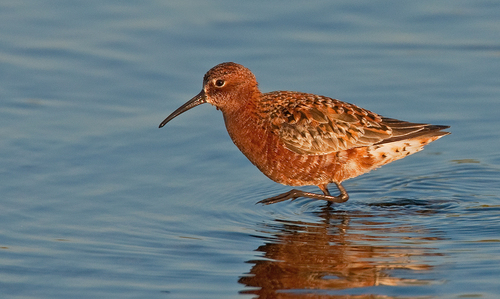
The bristle-thighed curlew, scientifically named Numenius tahitiensis (J.F.Gmelin, 1789), has a long, downward-curved bill and bristled feathers at the base of the legs. It measures roughly 40–44 cm (16–17 in) in length, with an average wingspan of around 84 cm (33 in); females are typically larger than males on average. This species matches the whimbrel in overall size and shape, and also has similar plumage: spotted brown upperparts, a light-colored belly, and a rust-colored or buffy tail. Several features set the bristle-thighed curlew apart from whimbrels: larger buff spots on its upper body, an unmarked light belly, barely marked flanks, distinct tail color, and a pale buffy-orange rump. During winter, this curlew lives in tropical Oceania, where its habitat range includes Micronesia, Fiji, Tuvalu, Tonga, the Hawaiian Islands, Samoa, French Polynesia, and Tongareva (Penrhyn atoll). Conservation concerns exist for this species related to habitat encroachment and introduced predators in its winter range. Though the species was first described in the 18th century, after James Cook’s visits to Tahiti, its breeding grounds were not confirmed until 1948. Its nesting areas are located on the lower Yukon River and the Seward Peninsula, where the birds favor low-lying tundra close to shorelines. Bristle-thighed curlews are rarely spotted near populated land areas, with only a small number of recorded sightings in Canada, California, and Oregon. When foraging, bristle-thighed curlews eat a wide range of foods including plant materials like flowers and berries, as well as insects, marine life, and the eggs of other birds. They use rocks to break open these eggs, which makes this species the only shorebird known to use tools for feeding.