About Numenius phaeopus (Linnaeus, 1758)
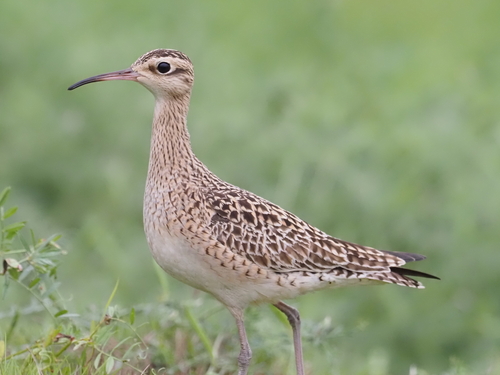
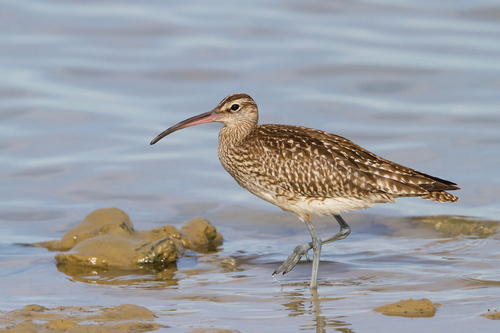
The Eurasian whimbrel (scientific name Numenius phaeopus (Linnaeus, 1758)) is a fairly large wader, and is mid-sized within the curlew genus. It measures 37–47 cm (15–19 in) in total length, has a wingspan of 75–90 cm (30–35 in), and weighs 270–493 g (9.5–17.4 oz; 0.595–1.087 lb). Its plumage is mainly greyish brown, and only the subspecies N. p. phaeopus and N. p. alboaxillaris have a white back and rump. It has a long curved beak that has a distinct kink, rather than a smooth curve. Its common call is a rippling whistle, and its song extends this call into a trill. Across most of this bird’s range, the only similar common species are larger curlews. Compared to these larger curlews, the whimbrel is smaller, has a shorter decurved bill, a central crown stripe, and prominent supercilia. The whimbrel is found in Ireland and the United Kingdom; it breeds in Scotland, particularly around Shetland, Orkney, the Outer Hebrides, as well as on the Scottish mainland in Sutherland and Caithness. It is a migratory bird that winters on coasts in Africa, South Asia, and Australasia. It remains coastal during migration, and is fairly social in groups outside of the breeding season. In Iceland, it lives in lowland plains, grasslands, and wetlands located in flat, wet areas with low vegetation, and occurs less often in higher elevation areas. This species feeds by probing soft mud to find small invertebrates, and by picking small crabs and similar prey from the surface. Before migration begins, berries become an important part of its diet. It has also been observed eating insects, specifically blue tiger butterflies.