About Numenius madagascariensis (Linnaeus, 1766)
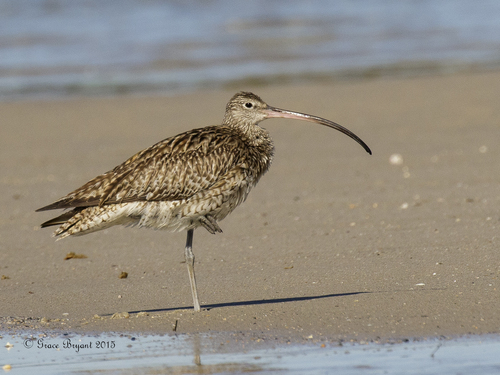
The Far Eastern curlew, with the scientific name Numenius madagascariensis, is a large wader species that most closely resembles the long-billed curlew in appearance, and is slightly larger than that species. Its plumage is mostly brown. It can be distinguished from other curlew species by its plain, unpatterned brown underwing and brown rump. This species is not only the largest curlew, but is also probably the largest sandpiper in the world. It measures 60–66 cm (24–26 in) in body length, with a wingspan of 110 cm (43 in). Its body weight ranges from 390–1,350 g (0.86–2.98 lb), a weight range that matches that of the Eurasian curlew. On average, females are approximately 100 g heavier than males. The Far Eastern curlew has an extremely long bill, measuring 12.8–20.1 cm (5.0–7.9 in) long. This bill size rivals that of the closely related long-billed curlew, making it one of the longest bills of any sandpiper. Its range overlaps with that of the eastern subspecies of Eurasian curlew, Numenius arquata orientalis; the Far Eastern curlew is most easily told apart from this subspecies by its brown rump and lower back, rather than the white rump and lower back of the Eurasian curlew subspecies. During the breeding season, the Far Eastern curlew lives in northeastern Asia, ranging from Siberia to Kamchatka, and also includes Mongolia in its breeding range. Its breeding habitat consists of marshy, swampy wetlands and lakeshores. Most Far Eastern curlews spend the non-breeding season in coastal Australia. Some individuals winter in Indonesia, Thailand, the Philippines, and New Zealand, where they occupy estuaries, beaches, and salt marshes. A small number of individuals winter as far north as southern China and Taiwan. During migration, Far Eastern curlews commonly make stopovers on the mudflats of the Yellow Sea, with some stopovers occurring along the coasts of Japan. The species uses its long, decurved bill to probe for invertebrates in mud. While it may feed alone, it generally gathers in large flocks for migration or roosting. Its call is a sharp, clear whistle rendered as cuuue-reee, which is often repeated.