About Numenius arquata (Linnaeus, 1758)
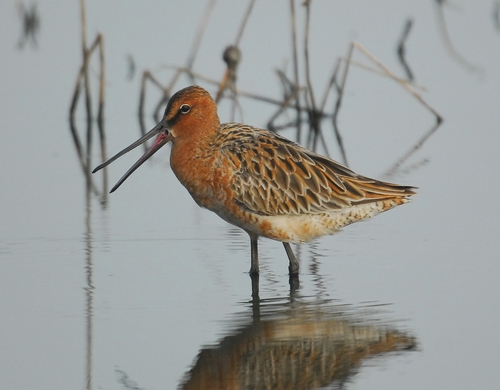
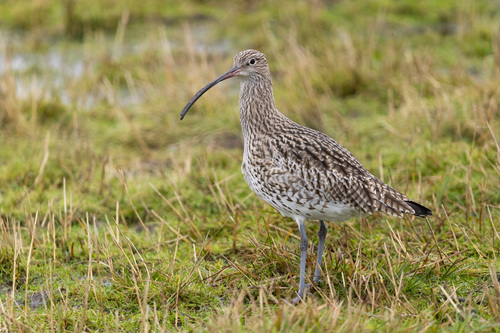
The Eurasian curlew, scientifically named Numenius arquata, is the largest wading bird within its range. It measures 50–60 cm (20–24 in) in body length, has a wingspan of 89–106 cm (35–42 in), and weighs 410–1,360 g (0.90–3.00 lb). Its plumage is mainly greyish brown, it has a white back, greyish-blue legs, and a very long curved bill. Males and females have identical appearance, but adult females have the longest bills. Because there is extensive individual size and bill variation, it is generally not possible to determine the sex of one or even several individual Eurasian curlews. However, sex can usually be told apart when observing a mated pair. The species' well-known call is a loud curloo-oo. The Eurasian whimbrel (Numenius phaeopus) is the only species that closely resembles the Eurasian curlew. The whimbrel is smaller, has a shorter bill, and its bill has a kink rather than a smooth curve. Eurasian curlews in winter plumage can also look similar to bar-tailed godwits (Limosa lapponica) in flight. Bar-tailed godwits are smaller in body size, have a slightly upturned beak, and their legs do not extend past their tail tips, while Eurasian curlews have longer feet that form a noticeable "point". Over most of its range, the Eurasian curlew is a migratory species. It spends the winter in Africa, southern Europe, and southern Asia. Occasionally, vagrant individuals travel far outside the species' normal range, reaching locations such as Nova Scotia and the Marianas. The species stays year-round in milder climate regions, including Ireland, the United Kingdom, and adjacent European coasts. Reclamation and drainage of marshy fields and moorland, along with afforestation of moorland, has caused local population decreases. In contrast, conversion of forest to grassland in some parts of Scandinavia has led to local population increases for the species. The Eurasian curlew is generally wary of disturbance, and is highly gregarious when outside of the breeding season. It feeds by probing soft mud to find small invertebrates, and will also pick up small crabs and earthworms from the surface when the opportunity arises.