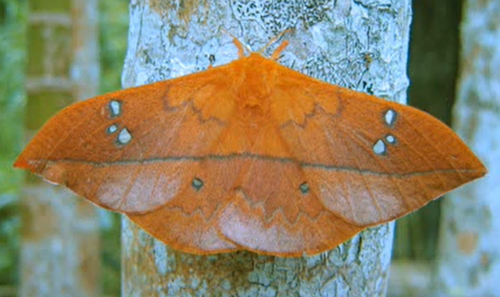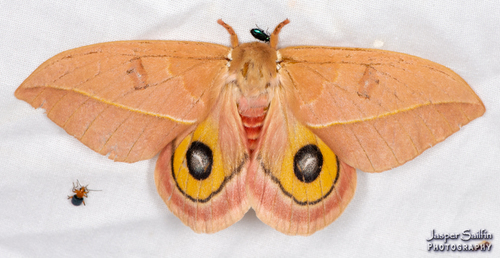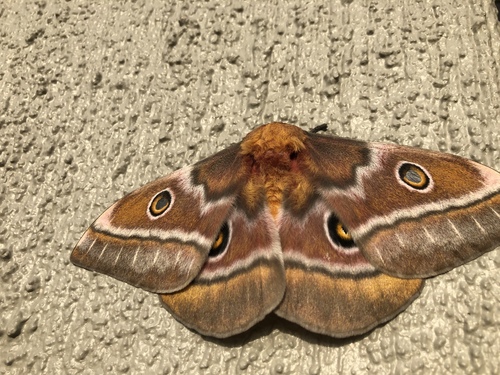
About Nudaurelia cytherea Fabricius, 1775
Nudaurelia cytherea, also known as the pine tree emperor moth or Christmas caterpillar (named for its festive colouration), is a southern African moth species that belongs to the family Saturniidae. Members of this family have large edible caterpillars that serve as an important source of protein for Bantu peoples in southern Africa. The genus Nudaurelia is closely related to the genera Gonimbrasia and Imbrasia, and this species was first formally described by Johan Christian Fabricius in 1775. The larva of Nudaurelia cytherea feeds on a very wide range of host plants. After introduced pines were established in the region, larvae readily added pine needles to their diet, causing widespread defoliation in South African pine plantations during the 1930s, with particularly severe damage occurring in the Lebanon and Franschhoek plantations of the Western Cape. The pine species eaten by the caterpillars include Pinus canariensis, P. halepensis, P. radiata, P. longifolia, P. muricata and P. pinaster. Other exotic host plant species eaten by the larvae include Acacia mollissima, Cupressus macrocarpa, Eucalyptus cladocalyx, E. diversicolor, E. globulus, E. ovata, E. paniculata, E. pilularis, Liriodendron tulipifera, apple, guava and quince. Before exotic plant species were introduced to southern Africa, the native food plants of Nudaurelia cytherea included Euclea species, Rapanea melanophloeos, Protea repens, Rhus angustifolia, Watsonia species and Myrica cordifolia. Of all available food plants, Pinus radiata and Rhus angustifolia are the most preferred by the larvae, and feeding migrations to other plant species only occur incidentally. A variety of hymenopteran parasitoids, including Hockeria crassa, Hockeria nudaureliae, Pediobius species, Anastatus species and Mesocomys pulchriceps, target the eggs and caterpillars of Nudaurelia cytherea. Larvae are also naturally infected by at least five distinct virus species, including Nudaurelia β virus, which causes fairly regular epizootic outbreaks. Insect viruses have long been used as biological control agents, as they cause far fewer negative effects on ecosystems than chemical pesticides. Their key advantages include that they require no follow-up management, and they are host-specific, a benefit that most non-specific chemical pesticides do not share. Mammals that act as natural control agents for Nudaurelia cytherea include baboons, feral pigs and porcupines, all of which readily eat the species' larvae, pupae and moths. In the 1930s, the Forestry Department introduced pigs to Western Cape pine plantations as a control measure, and this approach proved to be cheap and effective. Pigs can use their acute sense of smell to easily detect pupae resting under the soil surface.