About Nucifraga caryocatactes (Linnaeus, 1758)
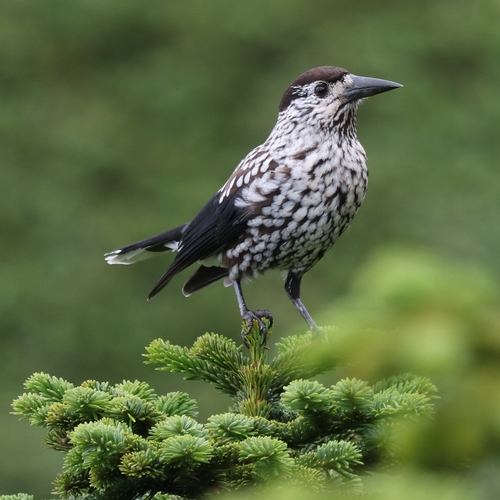
The northern nutcracker (Nucifraga caryocatactes) measures 32 to 38 cm in total length from bill tip to tail tip, with a wingspan of 49 to 53 cm. It is a broad-winged, short-tailed corvid with dark brown body plumage. Its body plumage ranges from mid to dark chocolate brown, with heavy white spotting across the face, neck, mantle, and underparts. It has a large white loral spot, a white eye-ring, and a blackish-brown cap that extends onto the nape. Its wings are dark blackish with a greenish-blue gloss, its vent is entirely white, and its dark tail has white corners on the upper surface and a white terminal band on the undertail. In flight, its broad wings, white vent, and short tail are easily visible, and its flight pattern is undulating. Its bill is black, ranging from slender to stout, is fairly long and sharply pointed, and varies in size between different subspecies. Its iris, legs, and feet are all black. Its voice is loud and harsh, somewhat similar to the voice of the Eurasian jay, but slightly lower in pitch and more consistently held to a single tone; it is described as kraak-kraak-kraak-kraak. The northern nutcracker has an extensive range that forms a broad east-west swathe stretching from Scandinavia across northern Europe and Siberia to eastern Asia, including Japan. In the north, it inhabits the large taiga conifer forests. Disjunct populations are found further south in mountain conifer forests, located in the mountains of central and southeast Europe: the Alps, the Carpathians, and the mountains of the Balkan Peninsula. Refer to the subspecies list above for distributions of individual races; some populations can be distinguished by bill size. This species has a very large global range, covering more than 10,000,000 km2 in total. It also has a large global population, with an estimated 800,000 to 1,700,000 individuals living in Europe. Northern nutcrackers are not migratory, but they will irrupt outside their normal range when a conifer cone crop failure leaves them with insufficient food. The thin-billed eastern subspecies N. c. macrorhynchos is the subspecies most likely to undertake these irruptions. Vagrants are recorded very sporadically in Britain, but in 1968 more than 300 nutcrackers visited Britain as part of a larger irruption into western Europe, likely caused by a period of early cold weather in Siberia.