About Nucella ostrina (Gould, 1852)
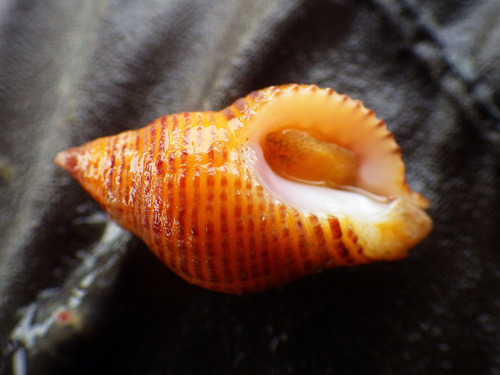
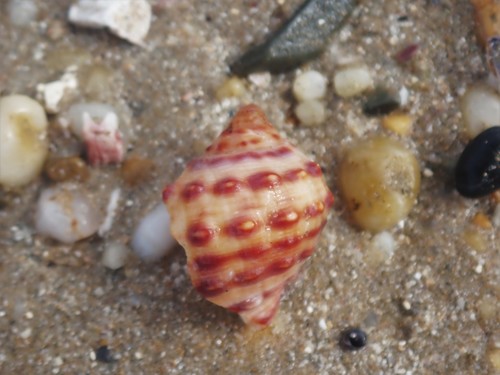
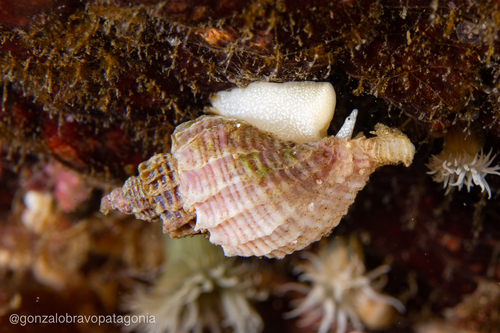
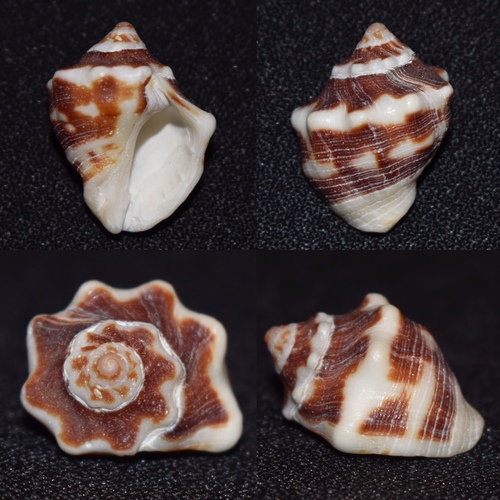
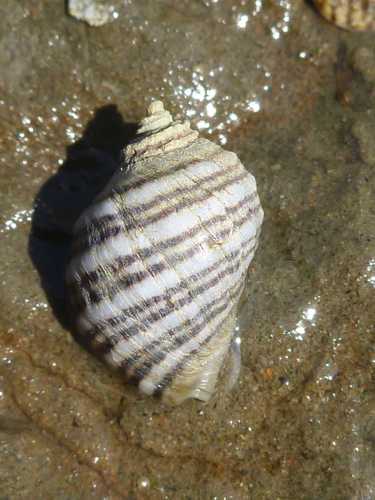
This dogwinkle, Nucella ostrina, has a robust shell with three indistinct whorls. Its maximum recorded length is 4 cm (1.6 in), while most individuals grow to 3 cm (1.2 in) or less. The shell aperture is less than half the shell's diameter, and can be closed by a brown, horny operculum. The shell exterior has spiral ridges, which often alternate between heavy ridges and more delicate ones. The heavy ridges may bear coarse nodules, but in more wave-exposed locations, these nodules and the ridges themselves may be partially smoothed. Ridges are typically pale in color, while the furrows between them are dark, most commonly brown, gray, black, orange or yellow. The interior of the shell is purple. Nucella ostrina is native to the northeastern Pacific Ocean. Its range extends along the western coast of North America from the Aleutian Islands, Alaska, south to Cayucos, California. It inhabits the intertidal zone of rocky coasts, often occurs near mussel beds, and is particularly common in wave-exposed positions. Like other members of its family, this dogwinkle is a predator. While each individual has unique food preferences, the species as a whole feeds predominantly on mussels and the barnacle Balanus glandula. It sometimes also preys on the periwinkles Littorina sitkana and Littorina planaxis, and the limpet Collisella scabra. It usually prefers the bay mussel Mytilus trossulus as prey over the California mussel Mytilus californianus. After selecting prey, the dogwinkle drills into the prey's shell with its radula, injects digestive enzymes that liquefy the prey's tissues, then sucks out the contents. Nucella ostrina is itself preyed on by the purple sea star Pisaster ochraceus and the red rock crab Cancer productus. This species lays its eggs in clusters of stalked capsules called "sea oats", which attach to rocks high in the intertidal zone. Each capsule holds around 550 eggs, but most of these eggs are infertile and are eaten by developing juveniles. Only 10 to 20 juveniles hatch from each capsule after three or four months, with no intermediate larval stage.