About Nucella lapillus (Linnaeus, 1758)
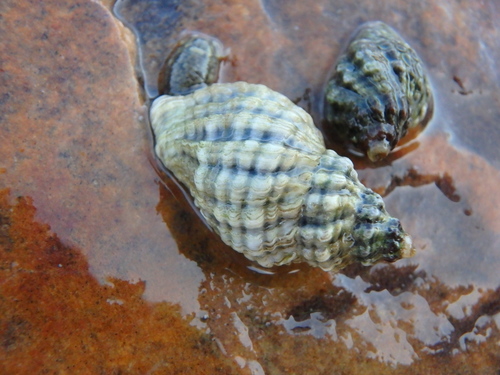
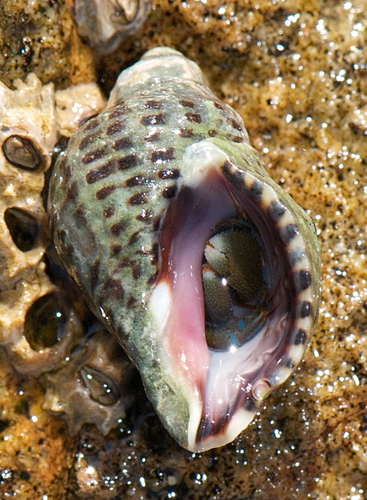
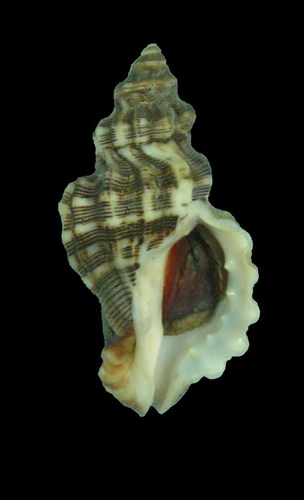
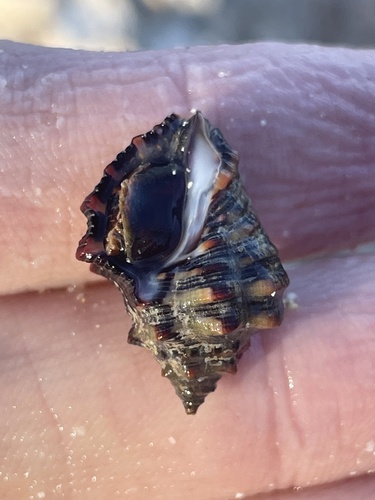
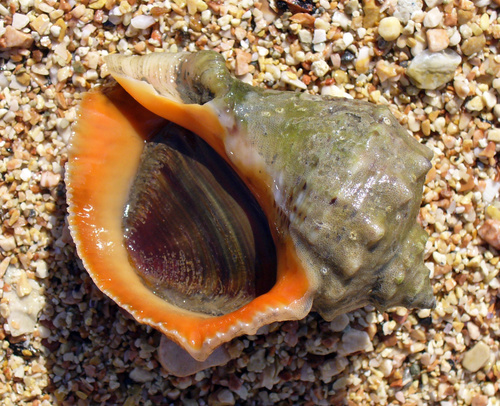
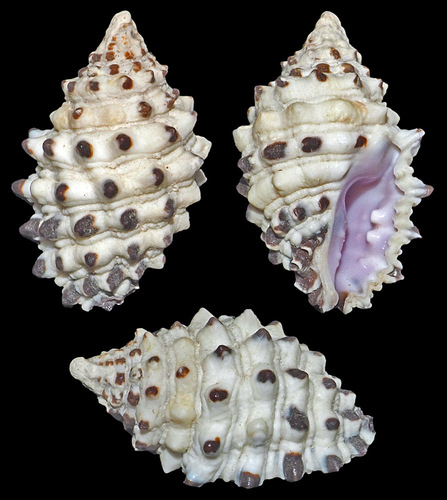
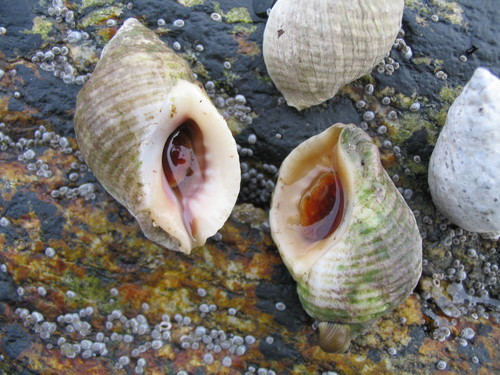
This section describes the shell of Nucella lapillus, commonly known as the dog whelk. The dog whelk shell is small and rounded, with a pointed spire, a short straight siphonal canal (a groove on the underside of the shell), and a deep anal canal. Overall shell shape varies widely based on how much wave action the shore where a population lives experiences, but the body whorl (the largest section of the shell that holds most of the snail’s visceral mass) usually makes up around three-quarters of the shell’s total length. The aperture is typically crenulated in mature dog whelks, and less often so in juveniles. The shell surface may be fairly smooth, marked only by growth lines; for snails living in more sheltered areas, the surface may be somewhat rough and lamellose. The shell’s surface is spirally corded. The outer lip has denticles and ridges on its inner side, and the columella is smooth. External shell colour is usually whitish grey, but can range widely through orange, yellow, brown, black, or any combination of these colours in bands. Occasionally, individuals may even be green, blue, or pink. This species is found along the coasts of Europe, the northern west Atlantic coast of North America, and in estuarine waters along the Atlantic coasts. It prefers rocky shores, where it feeds on mussels and acorn barnacles. The dog whelk lives on rocky shores and in estuarine conditions, and occurs in areas between the 0 °C and 20 °C isotherms. Wave action tends to restrict the dog whelk to more sheltered shores, but this can be counteracted both by adaptations that tolerate exposure such as its shell and muscular foot, and by avoiding direct wave exposure through using sheltered microhabitats in rocky crevices. The dog whelk prefers solid rock substrate over sand, which makes it harder for the species to survive at lower shore levels where weathering reduces seabed stability. The dog whelk either tolerates water loss through evaporation (using its operculum to hold water inside and prevent it from escaping as vapour) or avoids water loss by moving into water or a shaded area. Peak dog whelk population density is roughly coincidental with the mid-tidal zone, and the species lives primarily in the middle shore. In general, at high vertical positions on the shoreline, the dog whelk faces the most threat from biotic factors such as predation by birds and interspecific competition for food, though abiotic factors are the primary concern, as they create a harsh environment that is hard to survive in. At low vertical positions, biotic factors including predation by crabs and intraspecific competition create challenges. The upper limit of the species’ typical range is roughly coincidental with the mean high water neap tide line, and the lower limit is roughly coincidental with the mean low water neap tide line, meaning the vast majority of dog whelks occur in the mid-tidal zone. Tidal pools and similar microhabitats extend the vertical range of the dog whelk by providing a more constant environment, but these habitats are prone to increased salinity because evaporation concentrates dissolved substances, which can create toxic conditions for many species. The dog whelk can only survive out of water for a limited period, as it will gradually become desiccated and die. Metabolic processes within cells occur in solution, so reduced water content makes it impossible for the organism to function properly. Experiments have shown that 50% of dog whelks die at 40 °C. The dog whelk must excrete ammonia directly into water, as it lacks the adaptation that many upper shore species have, which allows them to produce uric acid for excretion without losing water. When kept out of water for seven days at 18 °C, 100% of dog whelks die; this contrasts with many periwinkle species, which can lose even more water (over 37% of their total body mass) than dog whelks but survive, thanks to their ability to excrete toxic waste products more efficiently. The dog whelk can be used to produce red-purple and violet dyes, just like its Mediterranean relatives: the spiny dye-murex Bolinus brandaris, the banded dye-murex Hexaplex trunculus, and the rock-shell Stramonita haemastoma, which provided the highly valued red-purple and violet colours of the Ancient World. Bede wrote that in Britain, "whelks are abundant, and a beautiful scarlet dye is extracted from them which remains unfaded by sunshine or rain; indeed, the older the cloth, the more beautiful its colour." In Ireland, on the island of Inishkea North, County Mayo, archaeologists discovered a 7th-century AD whelk-dyeing workshop. The site included a small, presumed dye vat and a pile of broken-open dog whelk shells. Unfortunately, no such workshop from the early medieval period is known from Britain. A confirmed trace of bromine, which indicates the presence of whelk dye, has been found on one page of an Anglo-Saxon manuscript known as the Barberini Gospels. This manuscript dates to the late 8th or early 9th century AD, and the whelk dye forms a background panel behind white lettering at the beginning of St John's gospel. Researchers have also searched for whelk dye on surviving fragments of Anglo-Saxon textiles, but chemical analyses carried out so far have tested negative for bromine. An Anglo-Saxon account of the accession ceremony of Aldfrith of Northumbria mentions whelk-dyed cloth, though this may simply be a poetic echo of Roman ceremonies. Another historical account mentions valuable textiles brought to England by Wilfrid of Ripon.