About Nucella canaliculata (Duclos, 1832)
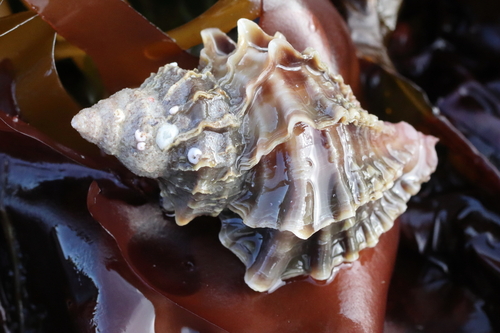
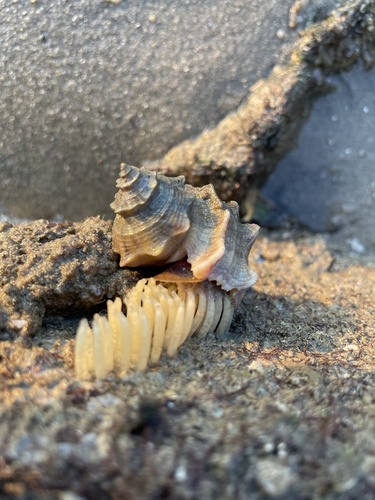
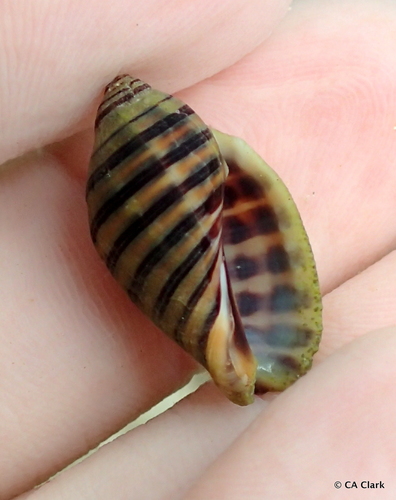
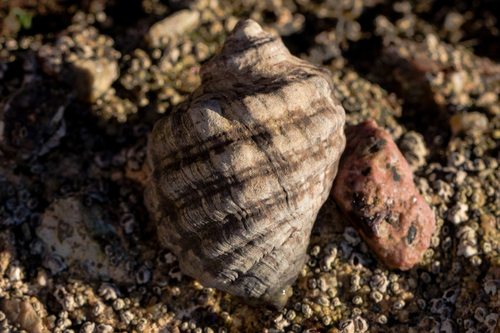
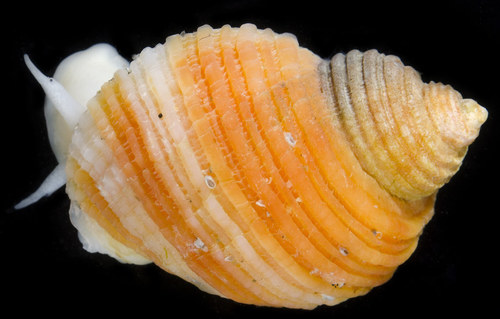
Nucella canaliculata has a robust shell with a strong spire, a short notch that holds its siphon, and can have up to seven whorls. The whorls are separated from one another by deep grooves, and are covered in many low spiral ridges that are roughly even in size. The shell has a matte surface; small individuals are often orange, while larger individuals are grayish or pale brown. The margins of the shell's aperture are often yellow, and the soft body of the snail is protected by a horny operculum. This species reaches a maximum length of about 4 cm (1.6 in). This dog winkle can be told apart from the frilled dog winkle (Nucella lamellosa) by its lack of frilled decorative structures, and from the northern striped dog winkle (Nucella ostrina) by the consistent even size of its sculpted shell ridges. This dog winkle is native to the Pacific coasts of North America. Its distribution ranges from the Aleutian Islands off Alaska to San Luis Obispo County, California, but it is uncommon in areas north of Puget Sound and south of San Francisco Bay. It lives on both exposed and sheltered rocks in the intertidal zone, and is especially common in wave-exposed areas of the Olympic Peninsula and near mussel beds. N. canaliculata is a predatory species that feeds on mussels and barnacles by drilling a hole through the prey's shell. Researchers have found that this dog winkle is more successful at drilling into the barnacle Semibalanus cariosus when it drills between the barnacle's lateral plates, rather than through the plates themselves. The snail injects a toxin through the drilled hole, which relaxes the barnacle's muscles and causes its opercular valves to open. Once the valves are gaping, the dog winkle can easily consume the barnacle's soft tissues.