About Nowellia curvifolia (Dicks.) Mitt.
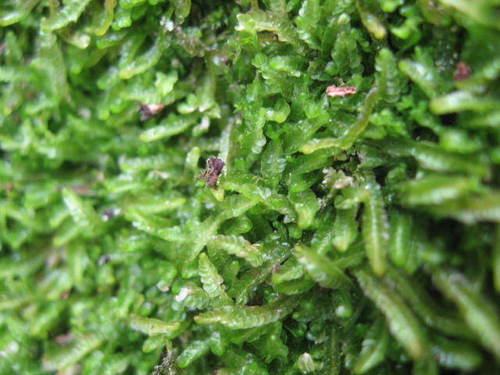
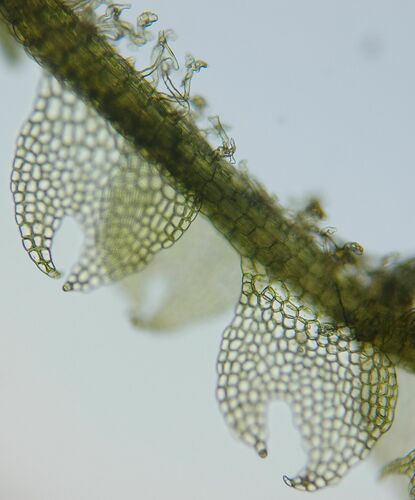
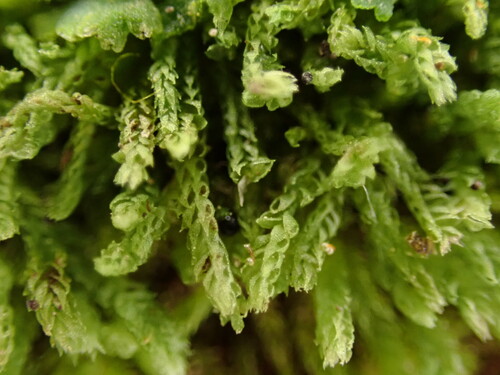
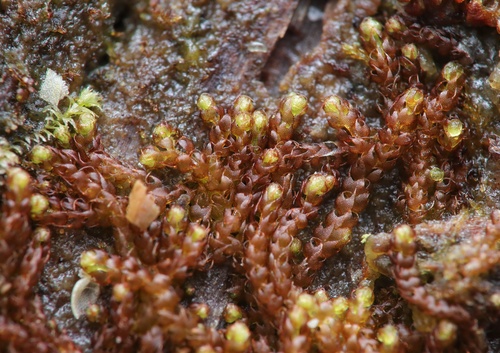
Nowellia curvifolia (Dicks.) Mitt. is a delicate liverwort that forms small, prostrate, or flat-lying, growths. Its coloration is striking, ranging from rose to purple to brown to spring green; reddish-purple pigmentation often develops during autumn and winter. Its most distinctive feature is its leaves, which are arranged in two rows along the stem and have a unique structure that makes them resemble tiny billowed sails. Each leaf is split into two pointed lobes, with the lower ventral lobe larger than the upper dorsal lobe. The edge of the lower lobe folds inward to form a specialized water-holding pocket called a water-sac, a trait that separates this species from its close relatives. The stem has a relatively simple structure: a single layer of large, clear outer cells called a hyalodermis surrounds a core of smaller, elongated inner cells. The plant anchors itself to its substrate via thread-like structures called rhizoids, which grow from the underside of the stem. These rhizoids develop branched tips where they make contact with the growing surface. This species reproduces both sexually and asexually. Asexual reproduction happens through specialized reproductive structures called gemmae: small, spherical, single-celled bodies produced at the tips of leaves. Sexual reproduction involves separate male and female plants, meaning the species is dioicous; female plants produce oval spore capsules that are reddish-brown when mature. The capsule opens by splitting into four parts to release its spores, and specialized coiled structures called elaters help disperse these spores. Nowellia curvifolia is very small: individual leaves measure less than half a millimetre, between 400 and 470 micrometres, across, so a hand lens or microscope is required to observe its detailed features. The species shows developmental plasticity. Research has found that when exposed to compounds that interfere with normal proline-hydroxyproline-protein synthesis, specifically hydroxy-L-proline and 2,2'-dipyridyl, N. curvifolia can develop morphological variations including ventral leaves, which are normally absent, and increased branching. These induced variations are temporary, and plants revert to their typical form once treatment ends. This suggests the species retains the genetic capacity to produce these alternative forms even though it does not normally express them. The species has been used as a model organism in scientific research to study plant cell wall proteins and developmental biology, particularly the role of arabinogalactan proteins in liverwort morphology and development. Nowellia curvifolia is a widespread Holarctic species, meaning it occurs across the northern temperate and subarctic regions of the world. Genetic studies of specimens from different regions have uncovered significant differences between populations: European and North American populations are genetically very similar, sharing 99.98% genetic identity, while Asian populations are much more genetically divergent, sharing 97.49% genetic identity with both European and North American specimens. This level of genetic differentiation suggests there may be cryptic species within the currently recognized N. curvifolia, particularly in Asia, or that distinct geographical races exist. Nowellia curvifolia grows on rotting logs in forests and acts as an important indicator species for forest ecosystems. It is particularly associated with certain myxomycete species such as Barbeyella minutissima, a rare slime mould found primarily in montane spruce-fir forests. N. curvifolia often forms nearly pure mats on decorticated, or bark-free, logs, prefers a pH between 4.6 and 5.2, and frequently grows as a pioneer species on decorticated logs.