About Novius cardinalis (Mulsant, 1850)
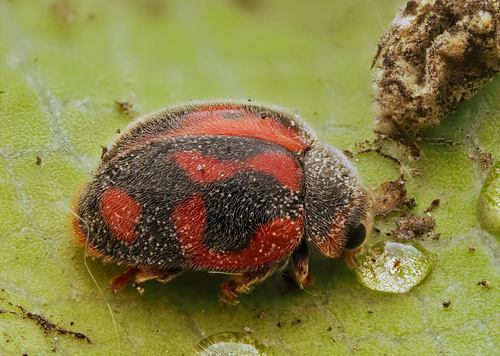
Adults of Novius cardinalis have a domed oval body that is flattened on the underside. They measure 2.5–4 millimetres (0.10–0.16 in) in length, and their bodies are covered with dense, short hairs. Their color forms an irregular, variable pattern of red and black, which can be more red or more black depending on the individual. The head, the back of the prothorax, and the scutellum are all black. This species feeds exclusively on the cottony cushion scale, Icerya purchasi, an insect that feeds on trees including acacia, citrus, magnolia, olive, and rose. Young larvae of Novius cardinalis eat the eggs of the scale insect, while older larvae and adult beetles eat all lifecycle stages of the scale. Novius cardinalis is native to Australia, and it has been introduced to citrus-growing regions of Europe and the United States. The eggs of Novius cardinalis are red. Females lay them either underneath the protective scale of host scale insects, or directly on the host scale insect's egg sacs. Each female lays between 150 and 190 eggs. First instar larvae have reddish bodies and legs. Older larvae have black tubercles on both the thorax and abdomen, as well as black legs. This species goes through four larval instars. Fourth instar larvae grow to around 5 millimetres (0.2 in) in length, and when they are ready to pupate, they attach themselves to a twig or leaf. The pupa is 4–5 millimetres (0.16–0.20 in) long, and its pupal case is off-white. Breeding in this species is rapid. Hot, dry regions can support as many as 12 complete generations per year, while cooler regions support about 8 generations per year. Females stop laying eggs if the temperature rises above 32 °C (90 °F).