About Novaculichthys taeniourus (Lacepède, 1801)
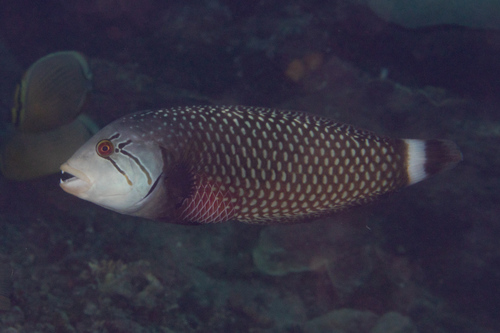
The rockmover wrasse, scientifically named Novaculichthys taeniourus (Lacepède, 1801), is a colorful fish that reaches 27–30 cm (11–12 in) in length. It has an oblong, laterally compressed body and a wedge-shaped head. Most of its head is scaleless, with the exception of two scales on the upper gill coverings and an almost vertical row of small scales behind each eye. Juveniles and adults have very different appearances. In juveniles, the first two dorsal fin spines are long and extended, drooping over the fish’s forehead to form a "cowlick". This elongated ray structure is lost as the fish matures into an adult. Adult rockmover wrasses have dark greenish-brown bodies, with an elongated white spot on each scale. Their heads are gray-blue, with brown lines radiating out from the eyes. Two black spots are located in front of the dorsal fin, and a wide vertical white bar sits at the base of the caudal fin. The posterior part of the caudal fin and the pelvic fins are black. Juveniles found in Hawaii are usually green, while juveniles from the western Pacific range from burgundy to brownish. All juveniles have white spots. Because the difference between juvenile and adult appearance is so striking, the common name "rockmover wrasse" is used for adults, while "dragon wrasse" is used for juveniles. This species is widely distributed across tropical reefs and lagoons in the Indian Ocean and Pacific Ocean. Adult rockmover wrasses live in shallow, semi-exposed reef flats, and also occupy lagoons and seaward reefs at depths of 14–25 m (46–82 ft). They prefer hard-bottomed grassy areas that are a mix of sand and rubble, with exposure to a mild surge. Juveniles prefer shallow rubble areas among large patch reefs, or protected open patches on reef crests. Very little is known about the reproduction of this species. Like other wrasses, they are likely able to change sex and are pelagic spawners, which means they broadcast eggs and sperm directly into the water column.