About Noturus miurus Jordan, 1877
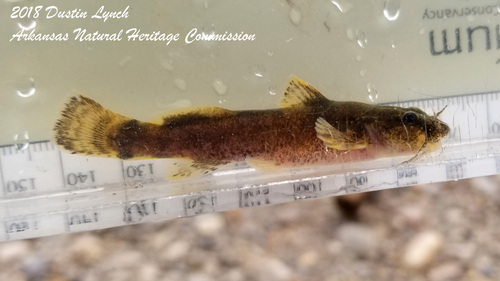
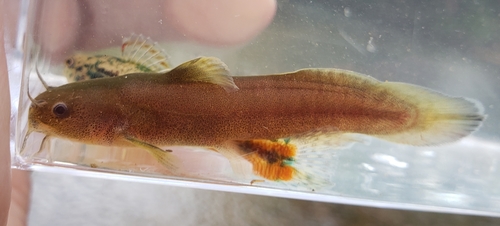
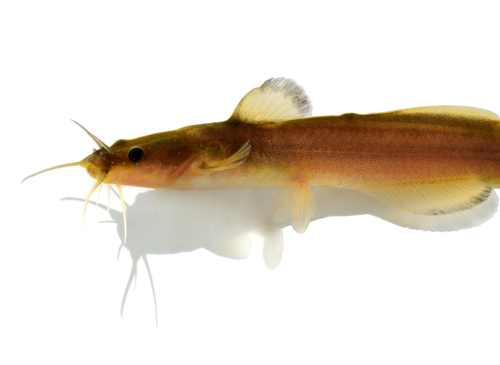
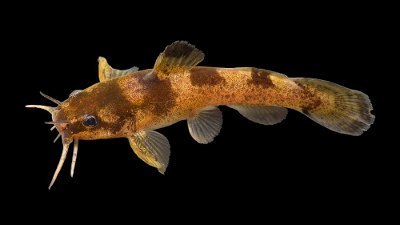
Brindled madtoms, scientifically named Noturus miurus Jordan, 1877, are typically 10.1 to 12.6 centimeters (4.0 to 5.0 inches) long. Like other species in the Noturus genus, the brindled madtom has an adipose fin fused to its caudal (tail) fin that extends from the caudal fin almost all the way to the dorsal fin. Its caudal fin extends around the caudal peduncle and ends just before the anal fin. This species has smooth, scaleless skin, and has four pairs of barbels along the premaxilla and dentary. Its caudal peduncle is laterally compressed, and the anterior section of its body, from the pelvic fins to the jaw, is dorsally compressed. The brindled madtom is light brown, with dark splotches on the dorsal fin tip and two distinct saddle-shaped marks located just behind the dorsal fin. The dorsal fin, which sits between the pectoral and pelvic fins, has a dark spotted blotch at its tip. The brindled madtom is distributed across the eastern United States, west of the Appalachian and Blue Ridge Mountains. Its range extends from the lower Great Lakes drainage southwest to Louisiana, and it is found in the Cache (Illinois), Huron, Mississippi, Ohio, Pearl, and Wabash river basins, as well as the Lake Pontchartrain drainage that flows into the Gulf of Mexico. This species is classified as endangered in Missouri, Kansas, Pennsylvania, and Michigan. In 1982, Burr and Mayden conducted a study that determined the brindled madtom's diet through dissection of stomach contents. The diet consists mostly of dipteran larvae and pupae, ephemeropteran naiads, trichopteran larvae, and adult isopods. Chironomids and simuliids were the most frequently eaten prey. Ephemeropteran larvae, including genera Potamanthus and Stenonema, were the second most frequently eaten, and trichopteran larvae (primarily the genus Chematopsyche) were third most frequent. Among crustaceans, Lirceus and a range of copepods were the next most important part of the diet. Worms, other microcrustaceans, other aquatic insects, fish, and plant material only made small contributions to the overall diet. Adult brindled madtoms are mainly preyed on by higher trophic level aquatic predators such as the longnose gar. Brindled madtom egg clutches are a food source for multiple opportunistic species including crustaceans, insects, and other fish. While most other Noturus species live primarily in riffles, the brindled madtom lives mainly in moderately silted pools with textured bottoms and mild currents. It thrives in clean benthic pool regions of swift streams and rivers with moderate silt coverage over a cobble or heavily textured bottom. This species does best in water with stable temperatures around 25 to 27 °C (77 to 81 °F). It does not tolerate temperatures above 30 °C (86 °F) well, and mass mortality has been observed at temperatures above 33 °C (91 °F).