About Noturus gyrinus (Mitchill, 1817)
Scientific name: Noturus gyrinus (Mitchill, 1817)
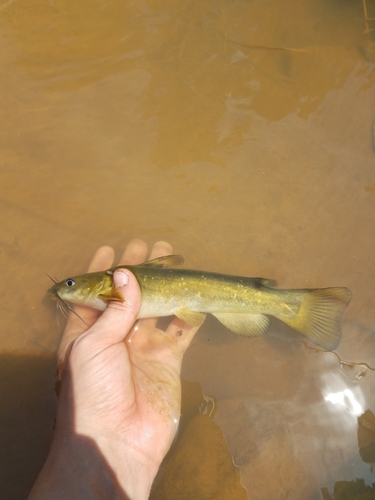
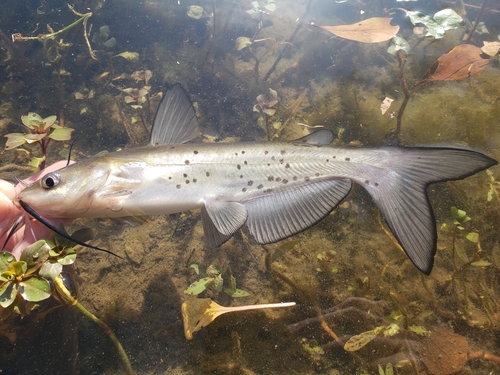
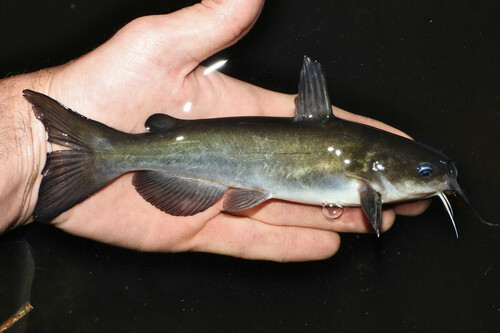
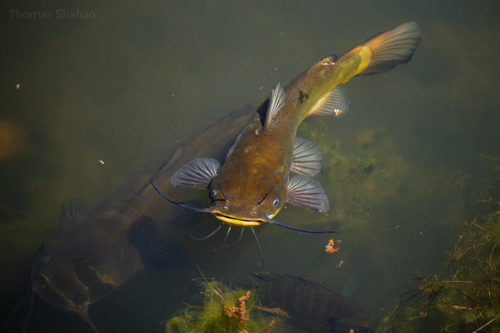
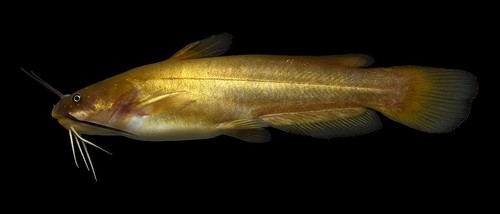
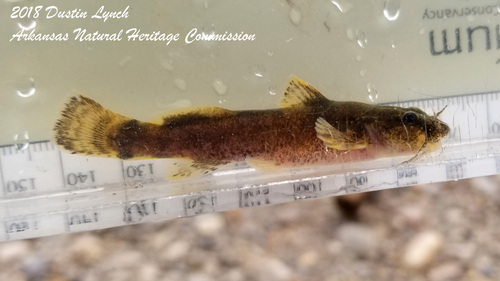
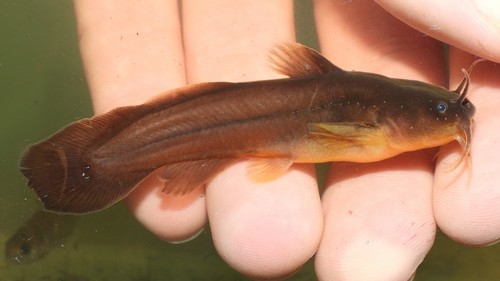
Description: Adult tadpole madtoms are typically 2 to 3 inches (50–80 mm) long, though individuals have been recorded reaching 5 inches (130 mm). This species has a dark brown back, lighter brown sides, and a yellow or white belly. In adults, the pelvic and pectoral fins are heavily covered in pigment-producing melanophores, while the dorsal and anal fins have far fewer melanophores. Bands of melanophores on both the upper and lower jaws form a dark horizontal streak along the side. Chin barbels range from white to lightly covered in melanophores; the nasal and maxillary barbels are dark, and the mandibular barbels are white. The adipose fin is fully connected to the large, round caudal fin, and the pectoral fin has no serrations. This species has 6–7 gill rakers, 6–7 dorsal rays, 15–18 anal rays, 7–9 pectoral rays, and 8–10 pelvic rays. The anal fin is moderately long, and its relative length decreases as the fish’s body length increases. Tadpole madtoms have two pectoral spines that deliver anti-predator venom. They have a terminal mouth lined with many small, sharp cardiform teeth arranged in multiple broad bands across both the upper and lower jaw.
Range and habitat: The tadpole madtom is native to parts of the United States and Canada. In Canada, it is native to Manitoba, Ontario, Quebec, and Saskatchewan, where it occurs in the Assiniboine, Saskatchewan, Souris, Red, English, Winnipeg, and Nelson rivers. In the United States, its range is extensive, stretching from Texas to Florida, then north along the Atlantic coast to New York. It also inhabits the Mississippi River valley and the Great Lakes basin. In Minnesota, it occurs in all drainage systems adjacent to the Red River basin. In North Dakota, it is found in the Missouri River drainage. In South Dakota, it occurs in eastern tributaries of the Missouri River (including the James River), as well as the Minnesota and Big Sioux river drainages. Tadpole madtoms live in habitats with little to no water current. They most often inhabit swamps, marshes, lakes, and slow-moving streams and rivers that are 0.1–1.5 meters deep and 12–24 meters wide. They prefer turbid water, soft bottoms of mud, sand, or gravel, and thick vegetation that they use for camouflage.
Reproduction and life cycle: Due to the tadpole madtom’s secretive behavior, little is known about its spawning habits. In most areas, spawning occurs in June or July, when water temperatures reach 80 °F. Breeding males develop swollen lips and genital papillae, along with enlarged muscles on the top of the head. Breeding tadpole madtoms do not build nests; instead, they attach their eggs to any available solid substrate, most commonly rocks, logs, and vegetation. They have also been recorded attaching eggs to submerged human trash like pop cans, and may use abandoned crayfish burrows to house their eggs. Females produce multiple clutches of eggs over the course of the breeding season, though the total number of clutches per female is not well documented. Each clutch typically contains between 75 and 200 eggs. Males guard the eggs until they hatch to protect them.