About Noturus eleutherus Jordan, 1877
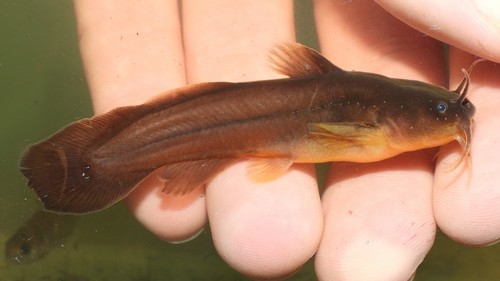
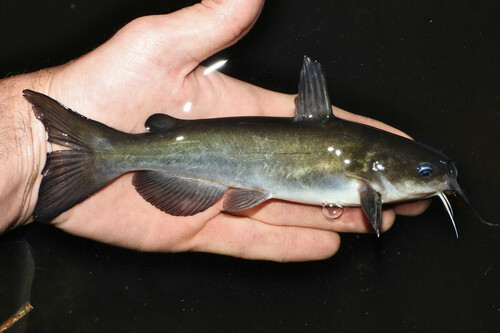
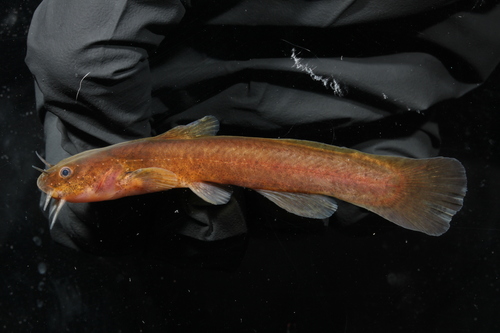
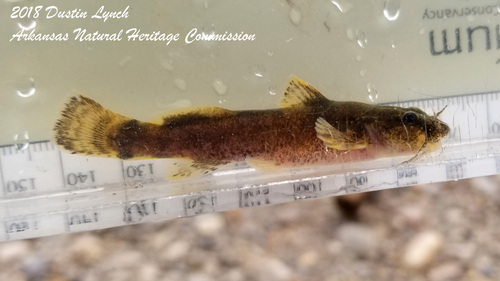
Noturus eleutherus, commonly called the mountain madtom, is a species of North American temperate freshwater fish in the Noturus genus of the Ictaluridae family. This species was first described to the United States National Museum by Professors Jordan and Gilbert from specimens collected in the Big Pigeon River, and was formally published by Jordan in 1877. The mountain madtom has a robust body, and its pectoral and dorsal spines carry a toxic sting. The population of this species that was lost from Pigeon River fisheries is currently the focus of restoration work by the Pigeon River Recovery Project. Outside of this project, very little management is applied to the species, and it is currently listed as a threatened species in the state of Tennessee. The mountain madtom has a broad native distribution within larger streams of the Mississippi River drainage, extending northeastward from the Little River system of southeastern Oklahoma. East of the Mississippi, it occurs through the Ohio drainage to western Pennsylvania. In the southeast, it is present in the Cumberland and Tennessee drainages. Within the Tennessee, Cumberland, and Green river systems, it is confined to the Highland Rim, and it can also be found in the North Fork Holston, Clinch, and Powell rivers. Generally, the mountain madtom is restricted to ridge and valley areas, and it does not live on the Cumberland Plateau, in high-elevation reaches of Blue Ridge mountain streams, in glaciated regions, or in streams with large boulders that lack vegetation. In the Ohio River basin, the mountain madtom and northern madtom occupy very similar environments, but usually do not occur together. The mountain madtom does not typically co-occur with other madtom species except the pygmy madtom (Noturus stanauli), though it has occasionally been reported alongside stonecat madtoms (Noturus flavus) in Ohio. The mountain madtom inhabits shallow, fast-flowing, clear riffles, typically in headwater streams. It is sensitive to siltation, so it is not found in areas with sandy substrate. Human activities like farming and logging that cause stream siltation degrade local mountain madtom populations. The species prefers intermediate-sized cobble substrate. In Pennsylvania, it has been observed in areas with dense vegetation. It is found in streams with primarily limestone substrate, which impacts the stream’s pH. The mountain madtom’s diet consists mainly of mature aquatic insects. A survey of 287 mountain madtom stomachs found the following percent composition by diet: 1.0% Plecoptera, 48.9% Ephemeroptera, 10.8% Trichoptera, 37.3% Diptera, and 2.0% miscellaneous. Based on its diet, the mountain madtom competes with Etheostoma blennioides, Etheostoma rufilineatum, and Cottus carolinae. The mountain madtom is a nocturnal feeder that hides under large flat rocks during the day. All members of the genus Noturus have pectoral spines; some species have serrated spines, some have venomous stings, and some have both. The mountain madtom has both serrated spines and a venomous sting, which function as an anti-predator defense, contrary to earlier beliefs that these structures were used to capture prey. Human activities such as dam construction harm mountain madtom populations, as the species prefers fast-flowing water.