About Notropis rubellus (Agassiz, 1850)
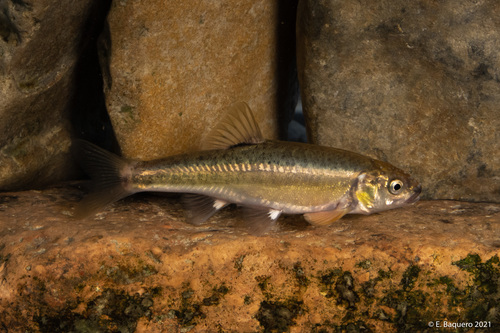
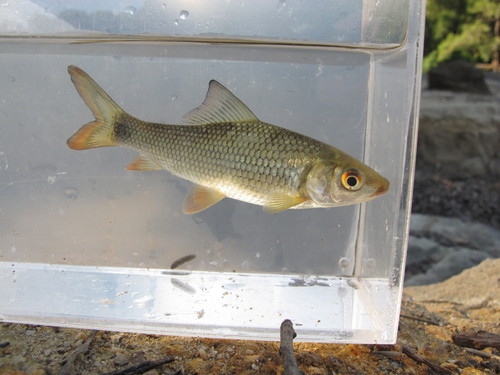
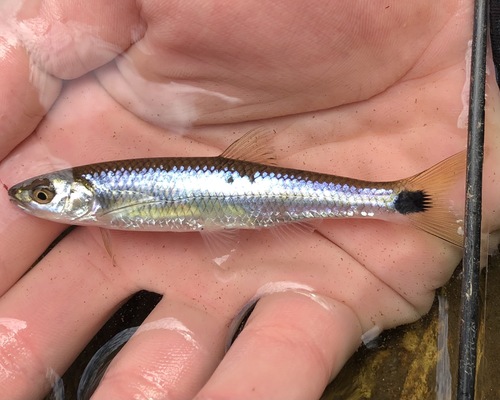
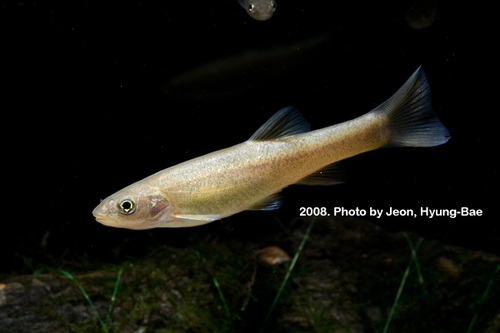
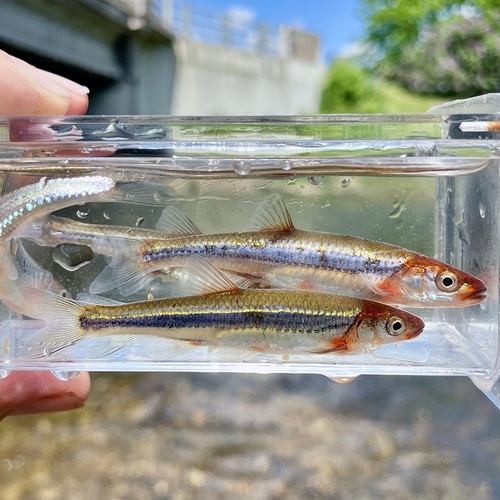
Notropis rubellus, commonly known as the rosyface shiner, can reach a maximum length of 9 cm (3.5 in). Individuals have a fusiform body shape, with silvery sides marked by blue and green iridescent lateral stripes and transparent fins. Their pectoral and pelvic fins are located in the abdominal region. They have a pointed snout and a terminal mouth, and their caudal fin is distinctly forked. Breeding males develop red coloration on their face, head, and the area behind their gills; breeding females also show faint red coloration. The native range of the rosyface shiner covers the eastern United States and southern Canada. It occurs from eastern Wisconsin and the Great Lakes drainages east to New York, south through the upper Ohio River, along the Appalachian Mountains and Cumberland Plateau to Tennessee, and down the James River and Rapidan River, which drain into the Atlantic Ocean. This is a nonmigratory freshwater fish that inhabits moderate to large clear streams with fast-flowing currents. Stream bottoms in its preferred habitat are made of clean gravel or rubble, typically in or near riffles. It does not thrive in streams with permanently murky water. Individuals overwinter from mid-November in deeper pools and eddies, and return to riffles in mid-March. Before spawning, schools containing both sexes circle between two pools located below spawning riffles; females make up the front of the school, while males occupy the rear. Spawning occurs on a riffle at the head of a pool, over gravel in the lower section of the riffle where water is 1 to 3 inches deep. Nests are depressions 5 to 12 inches in diameter. Multiple fish vibrate together over a depression for 5 to 6 seconds, rest for 30 seconds, and repeat this cycle for around 5 minutes before returning to the pool; this full cycle repeats every 10 minutes. Both sexes reach sexual maturity after one year of life. One-year-old females produce approximately 600 eggs, while 3-year-old females have an average fecundity of 1,175 eggs. The maximum lifespan of this species is three years.