About Notropis percobromus (Cope, 1871)
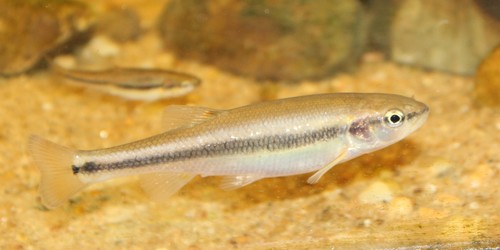
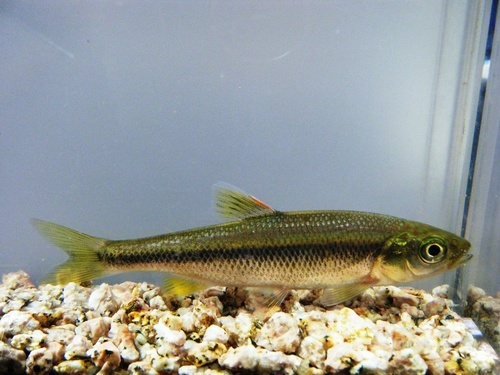
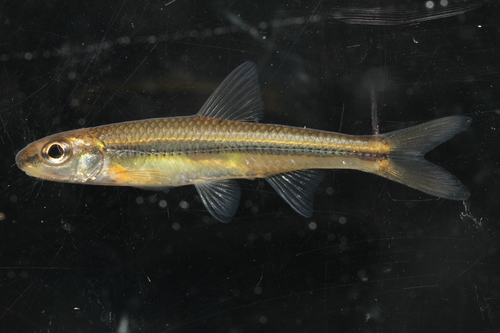
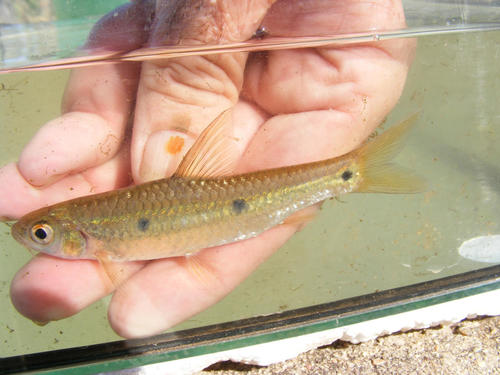
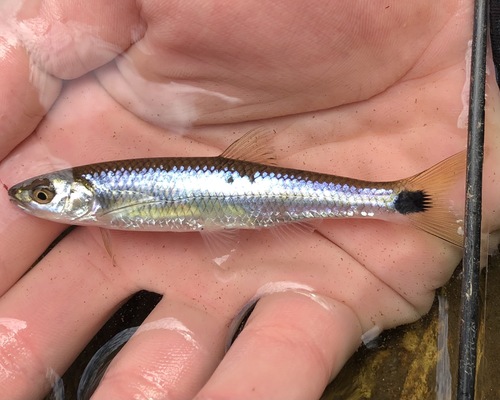
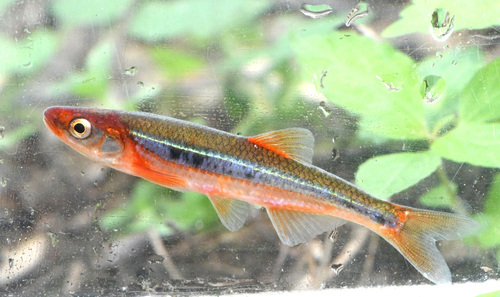
Scientific name: Notropis percobromus (Cope, 1871), common name: carmine shiner. This is a slender, elongate minnow, with a typical length of 55 to 60 mm (2.2 to 2.4 in) for individuals from the Whitemouth River. Its snout length is equal to its eye diameter. Adult carmine shiners are olive green on the dorsal side, silvery along the sides, and silvery white on the belly. Black pigment outlines the scale pockets on the dorsal area, and the opercula and cheeks may have a pinkish tint. Breeding males develop fine, sandpaper-like nuptial tubercles on the head, pectoral fins, and some predorsal scales. They also take on a pinkish violet color around the head, with a reddish tinge at the base of the dorsal fin. Breeding females are usually lighter in overall color. Carmine shiners rarely survive capture or handling, and their scales are easily dislodged. This species is distributed across eastern North America. In the United States, it is found throughout the eastern portion of the country, ranging west to North and South Dakota and south to Arkansas. In Canada, it has only been recorded in the Winnipeg River system, including the Whitemouth watershed. It may occur upstream as far as Lake of the Woods, Ontario. Manitoba populations are at the northwestern limit of the species' distribution, separated from the species' continuous range by 450 km (280 mi). Carmine shiners typically spend the summer at midwater depths of clear, fast-flowing streams and small rivers over clean gravel or rubble substrates. They often form schools in riffles and pools near the confluence of these waterways with larger streams and rivers. Habitat use during other seasons and by young-of-the-year has not been studied in Manitoba, and spawning behavior has also not been studied there. However, a ripe, running female was collected in the Pinawa Channel from water at 19.3 °C (66.7 °F). Southern populations of carmine shiners typically spawn in riffles during May and June, at water temperatures between 20 to 28.9 °C (68.0 to 84.0 °F). Adhesive eggs are deposited into depressions in gravel, often within the nests of other minnow species. At 21 °C (70 °F), eggs hatch within 60 hours, and newly hatched larvae move vertically into the gravel. These fish reach sexual maturity at one year old and live for approximately three years. Individual carmine shiners likely move into deeper water to overwinter.