About Notropis heterolepis Eigenmann & Eigenmann, 1893
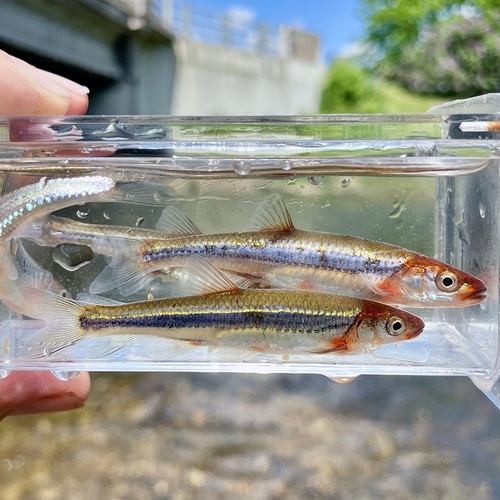
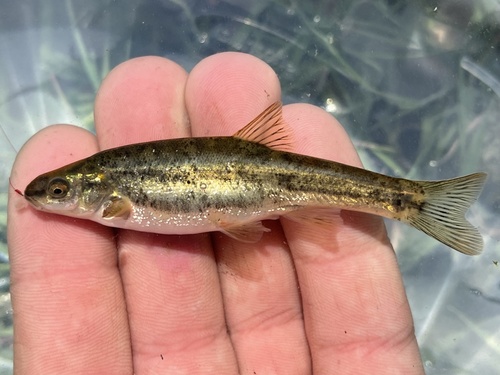
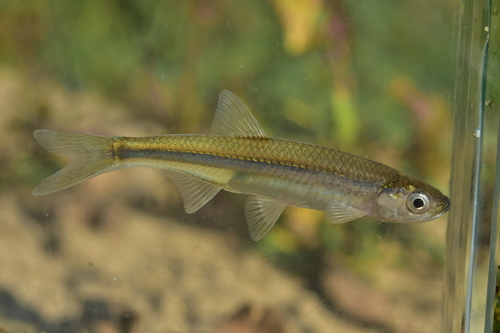
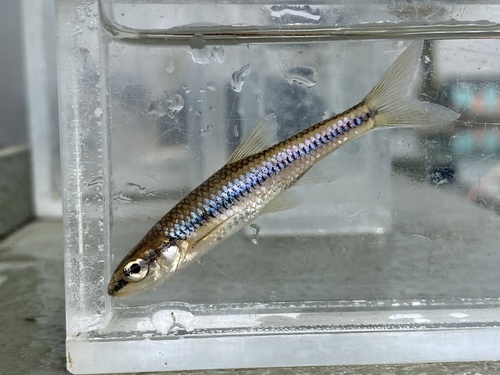
The blacknose shiner, scientifically known as Notropis heterolepis Eigenmann & Eigenmann, 1893, is a soft-rayed fish species that reaches a maximum length of 9.8 cm. It has toothless jaws, while its gill arches hold one or two rows of distinctive teeth. This species has cycloid scales, but its head is scaleless. It has 19 caudal rays, and both the dorsal and anal fins are very short. The anal fin is positioned closer to the middle of the body than to the caudal fin. Its dorsal side is usually murky yellow, with a pale underside. Two long lateral stripes run along the fish, one along the center of the body and one along the dorsal side. The blacknose shiner’s distribution extends across Atlantic, Great Lakes, Hudson Bay, and Mississippi River basins, ranging north to Nova Scotia and Saskatchewan, and south to Ohio, Illinois, and south-central Missouri. It is more common in the northern parts of its range, and appears to be declining in southern portions of its range; the last known collection of this species in Ohio occurred in 1982. It typically inhabits cool, weedy creeks, small rivers, and lakes with sandy substrates.