About Notropis buccatus (Cope, 1865)
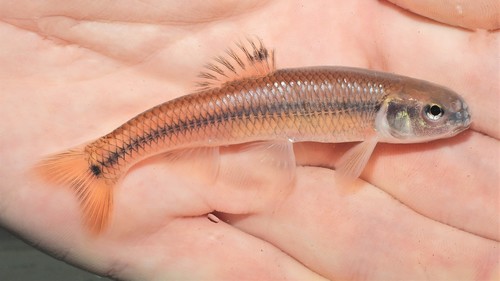
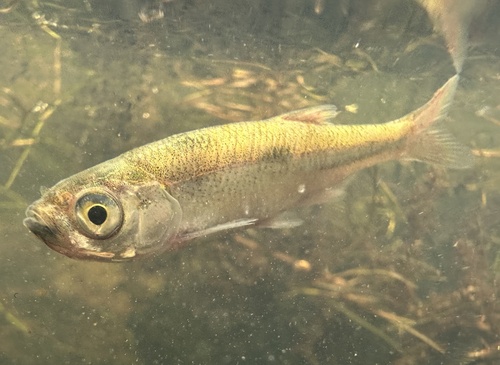
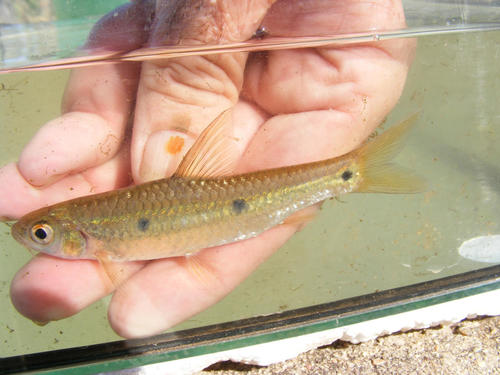
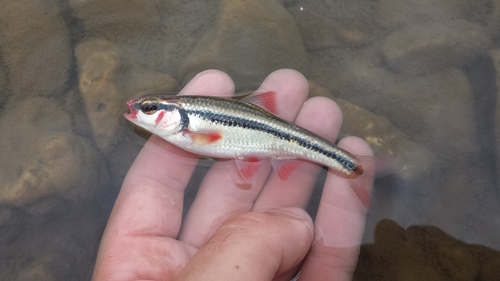
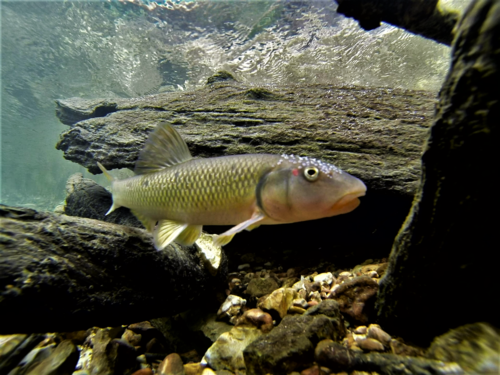
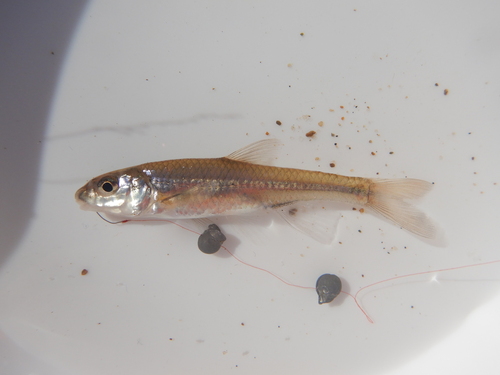
Notropis buccatus, commonly called the silverjaw minnow, has a lateral line system with many distinctive silvery-white pores that connect to an internal canal, which helps the fish detect prey. A shared trait of all minnows is that their dorsal fin has fewer than ten supporting structures called rays. Silverjaw minnows have eight soft-rays, which are thin, flexible membranous structures. Their dorsal fin sits above their pelvic region, where their ventral fins are located. They are light tan with a dark line on their back and have darkly outlined scales. The presence of breast scales is another defining feature that distinguishes silverjaw minnows from the longjaw minnow. These fish are edentulous, meaning they lack teeth on their jaws; however, they do have pharyngeal teeth in their throat. Their eyes are positioned nearly atop their heads and point upward. They have a slightly compressed body, with the deepest part of the body located near the back of their neck. Their long snout, which projects slightly past their subterminal mouth, is related to their feeding behavior as bottom-dwelling fish. Silverjaw minnows grow to a length of about 2–3 inches. This species has a disjunct distribution, with separate northern and southern ranges across the United States. The northern range stretches from eastern Missouri to Maryland, extending north into the southern Great Lakes and south to the Cumberland River Drainage in northern Tennessee. They are commonly found in the Chesapeake Bay, Ohio River, Mississippi River, and Atlantic Coastal tributaries. The southern range covers parts of Mississippi, Louisiana, Alabama, and Georgia. Major habitats within this southern range include the Apalachicola River and Pearl River drainages. Silverjaw minnows form large schools at the bottom of shallow, freshwater creeks, streams, and small to medium rivers with gravelly or sandy floors. They prefer the continuously moving water of riffles, and typically live in clear, silt-free waters. Silverjaw minnows have a typical lifespan of three to four years. Their eggs hatch between late spring and late summer. Growth occurs from May or June to the end of July during the fish's second and third summers. Growth stops during fall and winter months due to a slowed metabolic rate. They reach sexual maturity late in their first summer or during their second summer. Adults usually spawn in mid-spring, while spawning occurs in July for the previous year's offspring. Eggs are scattered along the bottom substrate.