About Notropis atherinoides Rafinesque, 1818
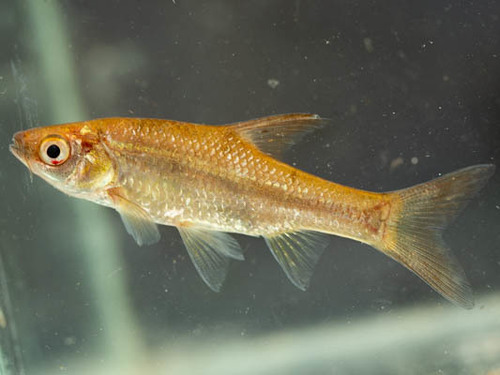
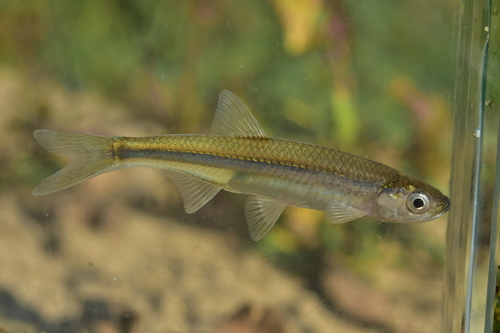
Notropis atherinoides, commonly called the emerald shiner, has a slender, laterally flattened and compressed body. Its transparent dorsal fin, which contains eight rays, sits directly behind the insertion point of the pelvic fins. This species has 9 to 12 anal fin rays, 35 to 43 lateral line scales, 19 to 20 pre-dorsal scale rows, 14 to 16 pectoral fin rays, and 8 or 9 pelvic fin rays. The mouth is large, positioned terminally at an oblique angle, and lacks a barbel. Its hooked pharyngeal teeth follow either the 2, 4–4, 2 pattern or the 1, 4–4, 1 pattern. Emerald shiners have a short, blunt snout; a deep continuous groove running across the midline separates the upper lip from the snout skin, and the cartilaginous ridge of the lower jaw is not very prominent.
Emerald shiners are native to North America, with a wide distribution across Canada, extending south to Virginia and Texas. Their range reaches the Gulf Coast from Texas to Alabama, and the species is especially common in the Mississippi Basin. It is likely the most abundant fish found in the Mississippi.
This is a freshwater benthopelagic species that lives in large open rivers, lakes, and reservoirs. In medium-sized habitats, emerald shiners prefer a temperature of 25 °C (77 °F), and are tolerant of low oxygen levels. They are a midwater or near-surface species that typically forms large or moderately sized schools. While some individuals tolerate turbidity in streams, others avoid turbid streams, and the species is most commonly found in clear water over sand or gravel substrates.
Emerald shiners are oviparous. Females spawn from late spring (mid-May) to late summer (mid-August). Spawning is temperature-dependent, and begins once water reaches a threshold temperature of around 22.2 °C (72.0 °F); in Canada, females have been recorded spawning in temperatures between 20.1 to 23.2 °C (68.2 to 73.8 °F). The species tends to spawn near the surface in open water close to boulders and gravel shoals. Eggs typically hatch between 24 and 32 hours. Emerald shiners are pelagic spawners that produce many buoyant eggs that have no or poorly developed respiratory organs, and very little pigment. Spawning takes place at night, around 1 to 2 feet below the water surface, with fish milling and darting in a circular path. Smaller males generally pursue larger females, and paired fish swim together in a circle. The male presses closely against one side of the female, interlocks their pectoral fins, and gyrates. The female then rolls over to release eggs, which the male fertilizes. Males reach sexual maturity at 55–60 mm in length, while females reach maturity at 65 mm.