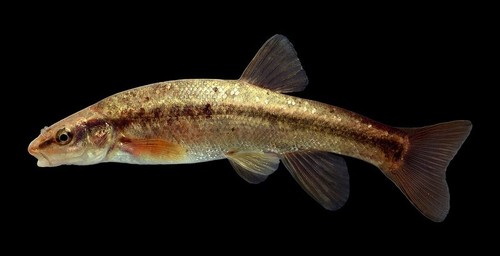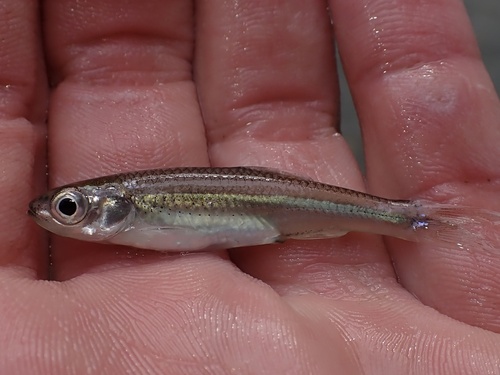
About Notropis amabilis (Girard, 1856)
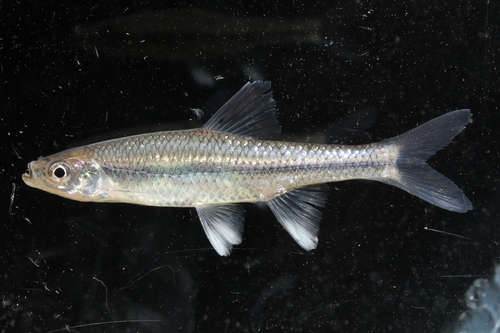
The Texas shiner, with the scientific name Notropis amabilis (Girard, 1856), is a species of ray-finned fish belonging to the genus Notropis. Its distribution ranges from the Colorado River to the Rio Grande drainage in Texas and northeastern Mexico, and also covers the Rio Salado and Rio San Juan systems in Mexico to the lower Pecos River in Texas.
The Texas shiner's macrohabitat is most often springs and headwater tributaries, where it can be very common. Small numbers sometimes also occur in larger streams. Collections from the Blanco River, Texas, and its tributaries show that N. amabilis is generally associated with flowing pools and deep runs, and avoids shallow high-velocity riffles and lentic backwater areas. It is abundant in deep pools with silt substrates in fall, and found in deeper pools and runs during both fall and winter. It typically inhabits clear waters with substrates that are usually sand, gravel, or rubble.
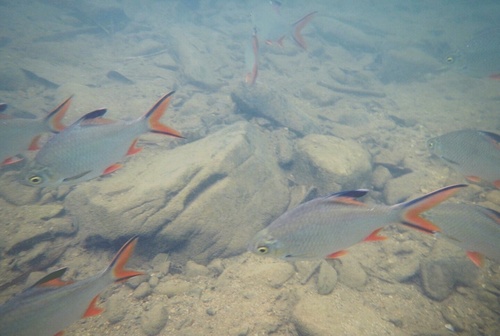
It is often found in moderately large schools in streams with moderately fast currents. It can occur at the upstream ends of pools below riffle areas, in swiftly moving waters along gravel bars, and in moderately flowing pools. It is also commonly found below low-water dams and road crossings where turbulent water flows. Where it lives alongside Cyprinella lutrensis and C. venusta, N. amabilis usually chooses areas with greater current velocity than the two other species, and also maintains the integrity of its schools to a greater degree than the other species. N. amabilis is rarely found in the upstream sections of tributary creeks, and is common in streams with significant spring flow components. It is dependent on currents, and is most often abundant in swift water areas; it often swims near the surface in eddies formed by upstream obstructions, and forms dense schools in swift moving water. In the Devils River, Texas, individuals were found in habitats intermediate between channels and pools before a flood, and shifted into riffles and riffle-like habitats after the flood. This study indicates that the species is adapted to a flood-prone life, which is typical for desert streams.
Gut content analysis identifies this species as an invertivore drift predator that feeds primarily on aquatic insects in the water column, according to Goldstein and Simon 1999. Common food items are aquatic insects (found in 71% of individuals) and algae (found in 61% of individuals). Among aquatic insects, mayflies are the most abundant, making up 31% of all consumed insects, followed by caddisflies at 26%, flies/midges at 22%, beetles at 12%, and moths/butterflies at 4%. Terrestrial insects were found in 6% of guts, and make up 5% of all identified insect taxa. Sediment and detritus were found in 13% of examined N. amabilis specimens. In the Devil's River, Texas, the species has been observed feeding near the surface. The few specimens collected in this area contained terrestrial insects during the summer, and no other information about the food habits of this species is available.