About Notophthalmus viridescens (Rafinesque, 1820)
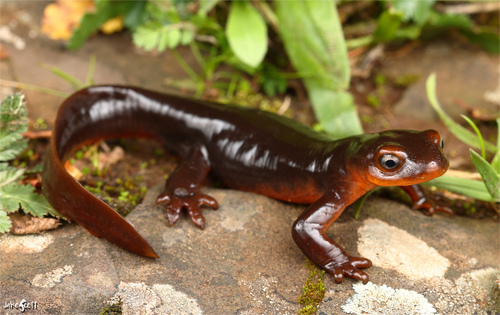
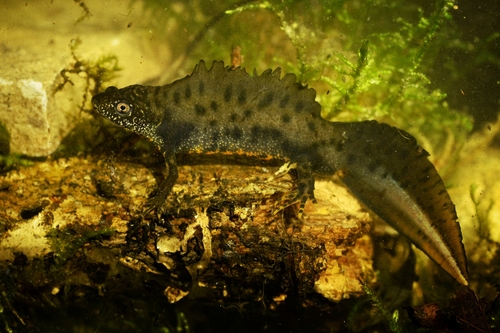
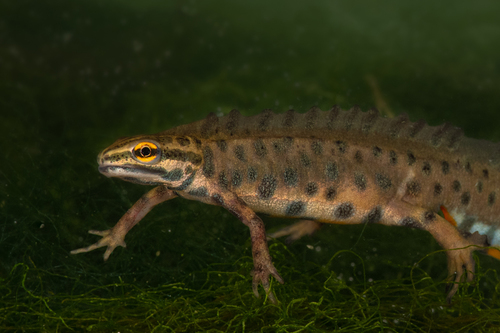
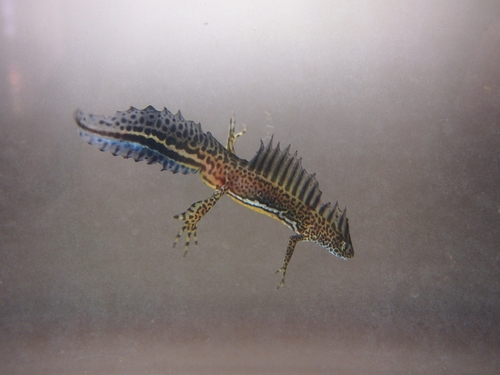
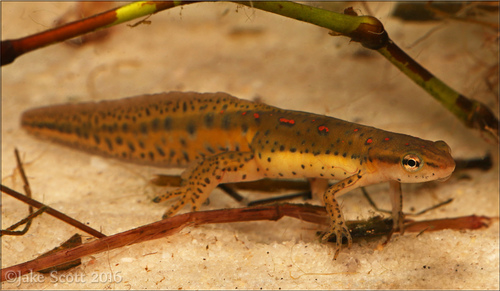
The eastern newt, with the scientific name Notophthalmus viridescens, is a common newt native to eastern North America. It is most often found in small lakes, ponds, streams, or the wet forests located near these water bodies. This species produces tetrodotoxin, which makes it unpalatable to predatory fish and crayfish. In the wild, eastern newts have a lifespan of 12 to 15 years, and can grow up to 5 inches (13 centimeters) in length. They are common aquarium pets, collected from wild populations or sold through commercial trade. The species has a distinct, striking bright orange land-dwelling juvenile stage called a red eft. Some sources combine the general species name and the name of the red-spotted newt subspecies to call the animal the eastern red-spotted newt, despite there being no corresponding 'western' newt with this naming convention. Eastern newts live in both coniferous and deciduous forests. Their preferred habitats include shallow water, quiet stretches of streams, swamps, ditches, lakes and ponds with dense submerged vegetation, and nearby damp woodlands. They require a moist environment with either a temporary or permanent body of water, and thrive best in muddy conditions. Male and female eastern newts have differing habitat preferences: males prefer more open, aquatic habitats, while females prefer more forested, terrestrial habitats. This difference may be linked to their distinct roles in reproduction, as males are typically more active during courtship, while females spend more time on land preparing to lay eggs. Eastern newts may travel long distances from their hatching location during the red eft stage. They are most active during warm rainy periods with temperatures above 53 °F (12 °C), and hide under leaf litter during dry weather. Red efts are often spotted in forests after rainstorms. Adult eastern newts prefer muddy aquatic habitats, but will move onto land during dry spells. Their skin contains toxins, and their bright skin coloration acts as a warning of this toxicity to potential predators. Only around 2% of eastern newt larvae survive to reach the red eft stage. Some larvae have been found living inside the pitchers of the carnivorous plant Sarracenia purpurea. Eastern newts breed once per year, with breeding occurring from late fall through early spring. They are polygynandrous, meaning both females and males mate with multiple partners. Males prefer to mate with larger females, and no evidence of female mating preference has been found. Breeding migration typically occurs during periods of higher rainfall. A male's spots attract females; he lures a female to him by fanning his tail, which releases pheromones. Once the female has chosen a mate, the male deposits a packet of sperm called a spermatophore on the ground. The female picks up this spermatophore to fertilize her eggs, and can store sperm for up to 10 months or longer. The female lays her eggs in water, attaching them to submerged vegetation or other submerged objects. A single batch contains 200 to 400 eggs, which have an incubation period of 3 to 8 weeks. For normal, healthy gonad development, fat bodies need to be located near the developing reproductive organs to support proper reproductive function.