About Notophthalmus meridionalis (Cope, 1880)
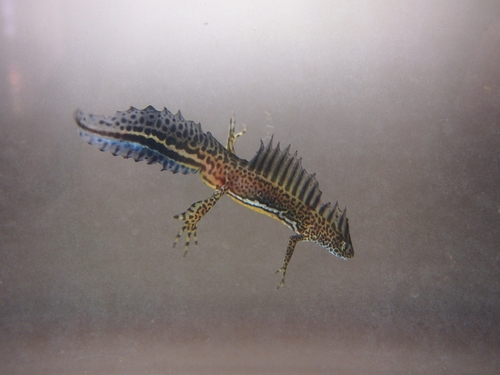
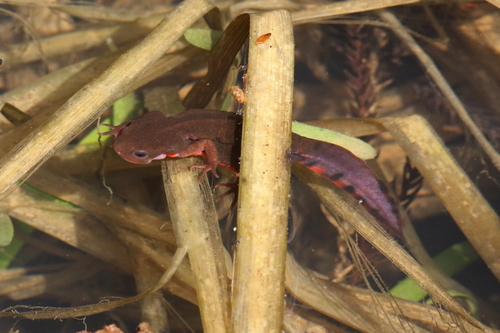
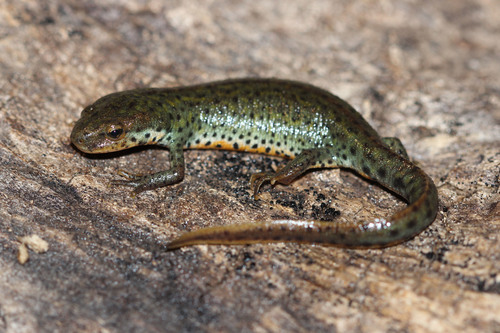
The black-spotted newt, scientifically named Notophthalmus meridionalis, is the largest living member of the Notophthalmus genus. For adults, the snout-to-vent length ranges from 42 to 57 mm, and females are larger than males. The full total length of this species is between 7.4 and 10.9 centimeters (2.9 to 4.3 inches). Its body is typically olive green with numerous black spots. The underside is usually yellow, and this yellow color sometimes extends up to the sides of the body. These light markings tend to combine into larger spots along the amphibian's sides, which eventually blend into a broken line running from the base of the head to the end of the tail. Sometimes, a pale brown or russet stripe runs down the newt's back. Its sides are blue-green, noticeably lighter than the back, and white often appears on the lower sides. The venter ranges from yellow to orange. Black-spotted newts have smooth skin, and a paddle-shaped, vertically flattened tail. Compared to the Mexican newt (Notophthalmus kallerti), the black-spotted newt has a lighter dorsum. Larvae of the black-spotted newt are generally gray-brown, with a dark midventral stripe. They also have small light-colored spots arranged in lateral or ventrolateral rows.
For habitat, black-spotted newts prefer shallow, heavily vegetated water habitats, though this type of habitat is uncommon in the northern part of the species' range. They can also be found among submerged vegetation. During the dry season, they are thought to burrow underground or stay under debris, usually burrowing less than two meters deep in these saturated, vegetated areas. When water dries up, they may also be found under rocks and other structures. If the water completely dries out and they are forced to leave their habitat, individuals are not believed to survive travel over long distances.
In terms of range, Notophthalmus meridionalis is found in the Mexican states of Tamaulipas, Veracruz, and San Luis Potosí, with a tiny range extension into northeastern Hidalgo and Puebla. It is also distributed in southern Texas along the Gulf of Mexico. The entire Notophthalmus genus is exclusive to North America, with three existing species: the eastern newt (N. viridescens), the black-spotted newt (N. meridionalis), and the striped newt (N. perstriatus). The eastern newt ranges across eastern United States, while the black-spotted newt is restricted to southeastern Texas and northeastern Mexico. It is hypothesized that the divergence of the black-spotted newt from its common ancestor started around the late Miocene epoch. When North American tropics retreated south, the Southeastern American plate became isolated. This biogeological event led to the divergence of Notophthalmus meridionalis in eastern Mexico and Notophthalmus perstriatus in Florida.