About Notonecta undulata Say, 1832
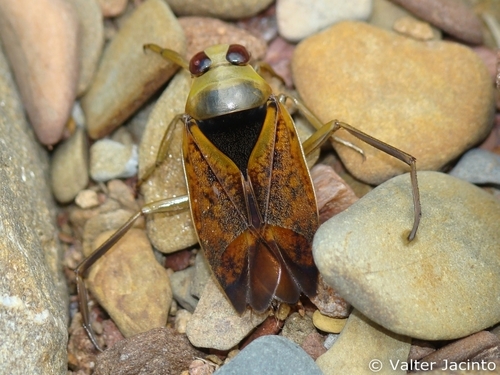
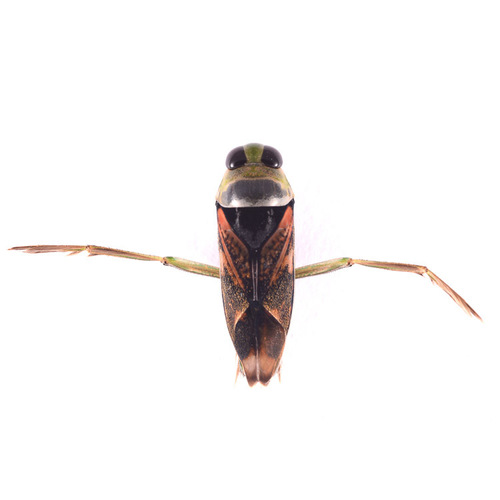
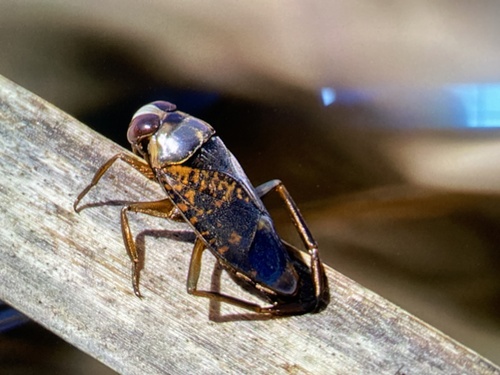
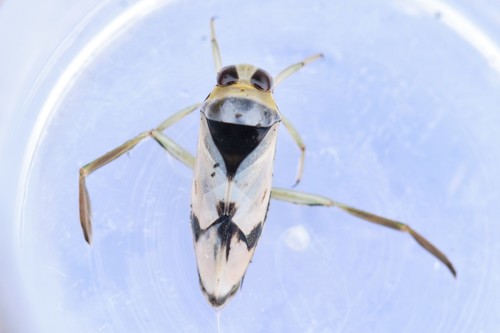
Notonecta undulata Say, 1832, commonly called the grousewinged backswimmer, is a species of true bug in the suborder Heteroptera. It belongs to the family Notonectidae, which is split into two subfamilies: Notonectinae and Anisopinae. Members of Notonectinae can be told apart from Anisopinae by their 4-segmented beak and antennae, and Notonectinae insects are also larger, generally measuring 10–16 mm in total length. N. undulata individuals reach 10–12 mm in length. Their body color ranges from dull greenish yellow to black. The back of the head is convex, and their short antennae are concealed beneath the eyes. The scutellum is usually black, with pale spots on its sides and apex. The hind tibiae and tarsi are covered in dense bristle-like hairs that give them an oar-like shape, which makes these backswimmers efficient swimmers. However, recorded observations note that members of the genus Notonecta are not as strong swimmers as species in the genus Buenoa. The front and middle tarsi have apical claws, while the hind tarsi are completely clawless. Grousewinged backswimmers have five points across their body — the anterior legs and abdomen — that allow them to attach to water's surface film. Each of these points has associated receptors that help the insect with locomotion and capturing prey. This species also lacks ocelli; researchers suggest the ability to detect light was likely lost via natural selection due to different environmental pressures. Their beak is stout, and the ventral surface of the abdomen has a prominent hairy keel. The front and middle legs are roughly half the length of the hind legs, and the femur is enlarged at its base. The wing membrane has a large black spot along its median line, and the hemelytra are pale. Before 1917, there was no complete description of the genus Notonecta, until H. B. Hungerford described N. undulata in the Kansas University Science Bulletin. Today, N. undulata remains poorly documented in scientific literature. Most existing references and taxonomic work on the species date to between the 1920s and 1970s, with only a small number of articles published after the 1990s. The species' accepted taxonomic classification has not changed from what it was 40 years ago. N. undulata most commonly lives in ponds and lakes, but will move to small streams or rivers when resources in these still-water (lentic) habitats become limited or competition is too high. Backswimmers can fly to find and settle in habitats with better conditions. Research has found that grousewinged backswimmers have a higher dispersal rate when predation levels in their current environment increase. Ponds have a higher vegetation surface area to water volume ratio than lakes, which creates more hiding spots and more food for the insects, making ponds one of the most ideal habitats for this species. N. undulata distribution depends on food supply, which explains this preference: ponds and wetlands have higher organism diversity, which correlates with greater nutrient and food resources. Temperature also impacts the distribution of grousewinged backswimmers. Scientific studies show that N. undulata can survive across a wide range of temperatures and water conditions. They can tolerate temperatures from 4 to 32 °C, and water hardness from 28 to 220 ppm. In natural settings, they avoid temperatures over 32 °C by flying to find new habitats, but can withstand higher temperatures for short periods using a cuticular lipid monolayer. This physiological adaptation lets them take up water and avoid dehydration when temperatures are high. Water pH also influences the backswimmer's habitat choice. Recorded observations show N. undulata prefers a pH between 6.0 and 7.1, which is typical neutral freshwater. Environmental factors including pH, temperature, and trophic interactions all shape the ecology of the grousewinged backswimmer. Predator-prey interactions are another key ecological factor for the species. Backswimmers in the genus Notonecta are generalist predators that attack and eat many types of aquatic invertebrates, as well as terrestrial prey that fall onto the water's surface. They are known to feed on small crustaceans, nymphs and adult corixids, dragonfly nymphs, caddisflies, and fish eggs. N. undulata specifically prefers to eat mosquito larvae over all other types of invertebrates. Multiple studies have investigated this interaction between grousewinged backswimmers and Aedes aegypti, a mosquito species that acts as a vector for malaria and yellow fever. As a result, N. undulata has been proposed as a suitable candidate for biological control of vector mosquitoes. Grousewinged backswimmers are bivoltine, meaning they produce two generations per year. Females of the first generation reach adulthood and reproductive maturity in July, and go on to produce the species' second generation. Adults that reach maturity after July enter reproductive diapause that ends in late October. All N. undulata overwinter in the adult life stage, and begin laying eggs in early spring. Eggs develop into adults through five nymphal instars over the course of spring and summer. The preoviposition period lasts 16 days, and females usually lay eggs in ponds or calm lakes rather than fast-flowing streams. Eggs are attached to aquatic plants or other suspended objects in the water column. They are shaped as elongate ovals, and typically measure 1.7 mm by 0.6 mm. The egg incubation period lasts 5–14 days, and oviposition continues continuously through the summer.