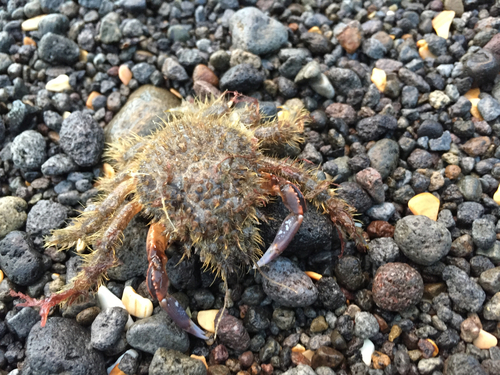
About Notomithrax ursus (Fabricius, 1787)
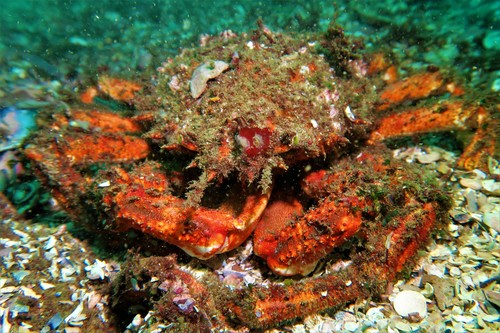
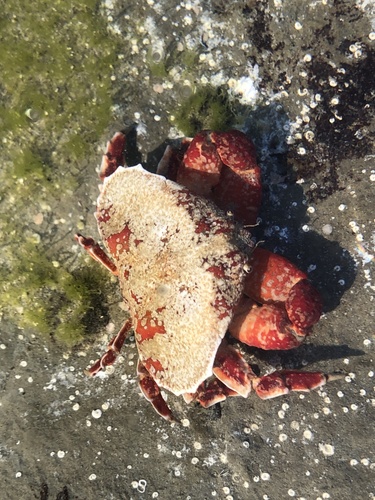
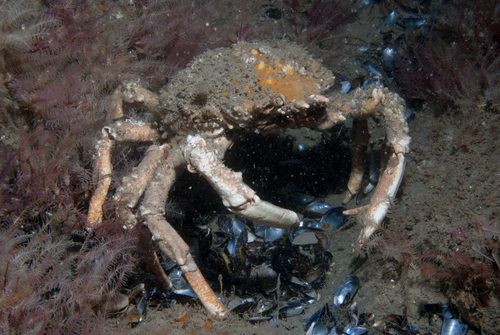
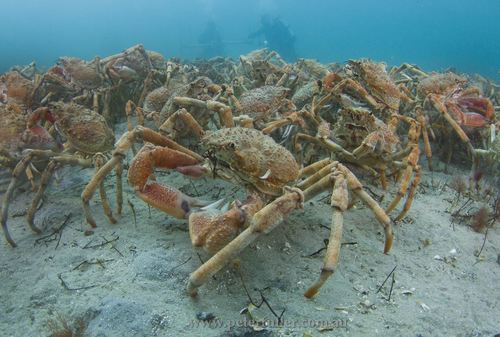
This crustacean species has a hard, rounded-triangular carapace (shell) covered in hair-like projections of varying sizes. The carapace is 1.3 times longer than it is wide, and its surface bears many tubercles, with spines running toward the front and sides of the shell. The edges of the carapace have nine outward-pointing sharp spines: three supraorbital, three hepatic, and three brachial. Two spines at the front of the crab’s head form a V-shape and are covered in small bristles. Some bristles across the carapace are short and hooked, while others are long and straight. The abdomen has seven segments in both sexes; the male abdomen is narrower, and all segments are broader than they are long. Legs are longest at the front and become progressively shorter toward the back. The crab has three pairs of walking legs, one pair of swimming legs at the back, and one pair of front claws called chelipeds. Walking legs are long and slender; the back of each walking leg has a longitudinal row of short hooked bristles, mixed with long straight bristles. The pincers are orange or red with white tips, and the legs are covered in brown hairs. As a decorator crab, N. ursus attaches local seaweed or algae to the hooked hairs on its body, to gain camouflage on the ocean floor. Hairy seaweed crabs regularly update their camouflage, replacing 10-20% of their algal covering each day, and like other spider crabs, this gives them very slow, sluggish movement. This antipodean species is native to New Zealand and south-eastern Australia. In New Zealand, it is widely distributed across shorelines of both the North and South Islands, and is also found on Stewart Island and the Chatham Islands. It inhabits coastal areas around rocks in tide pools and the intertidal zone. Its bathymetric range extends to 75 meters, meaning it can be found in waters up to this depth, though it occurs mostly in shallow water. Crabs living in deeper water usually do not exhibit masking behaviour. It is negatively phototactic, meaning it moves away from light, so it often buries itself in sand or hides among seaweed. Female hairy seaweed crabs lay fertilized eggs, in which larvae develop before hatching. Freshly laid eggs are bright orange, turn brown as hatching approaches, and measure approximately 0.75mm across. Larvae go through multiple developmental stages before reaching maturity: pre-zoea, zoea 1, zoea 2, and megalopa. When a larva first hatches, it is enclosed in a thin, transparent covering that it sheds shortly after hatching. The larva then enters the first zoea stage, where it measures about 3.0mm. Zoea 1 lasts 8–16 days, after which the larva sheds its exoskeleton and enters the zoea 2 stage, where it is about 3.5mm long. At a temperature of 16 degrees Celsius, the larva develops into the megalopa stage after 12–15 days. After 20 more days, the megalopa moults into a juvenile crab. Juveniles and adults moult (shed their shells) every few months to grow, and grow faster in warmer water. Adult seaweed crabs typically reach 5cm across the carapace, and live for approximately two years.