About Notolabrus tetricus (Richardson, 1840)
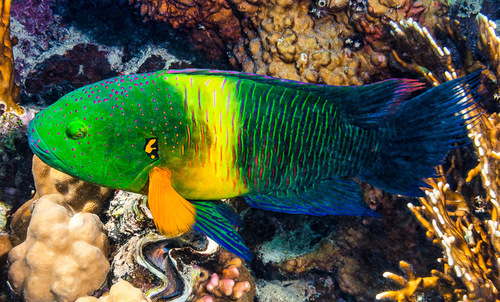
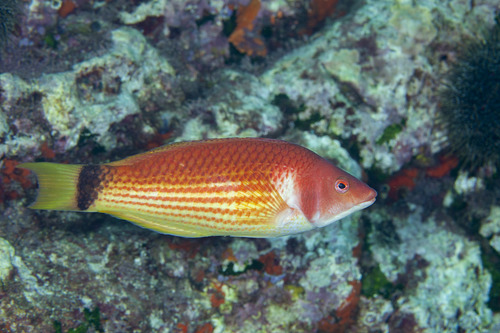
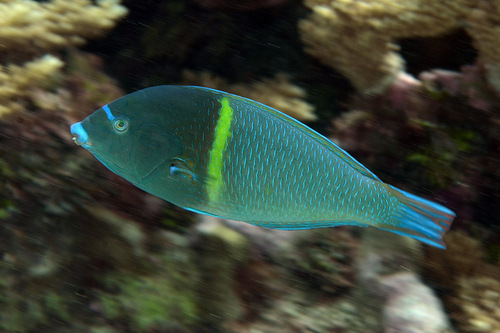
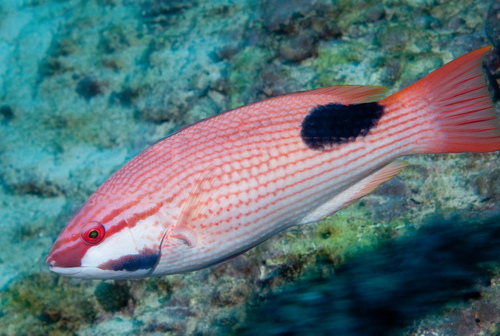
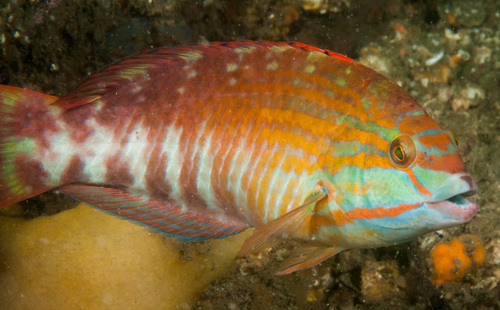
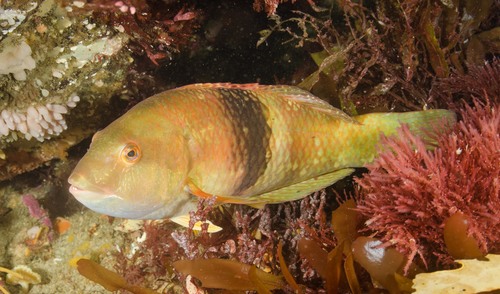
Notolabrus tetricus, commonly known as the blue throated wrasse, has a moderately deep body and a somewhat rounded snout. Male blue throated wrasse vary in color, and can have body backgrounds that are greyish, greenish-blue, or reddish-orange. Their heads are pale, with a blue chin and throat, while their pectoral, pelvic, and anal fins are yellow. A distinct thick white vertical bar runs across the middle of the body. Females and juveniles are greenish or brownish with a mottled pattern, and often have a large vertical body patch, with smaller white patches adjacent to it. Older females develop paler coloration behind the vertical bar. This species can reach a maximum total length of 50 centimetres (20 in); males most commonly grow to 30 to 45 centimetres (12 to 18 in), while females normally reach 20 to 35 centimetres (7.9 to 13.8 in). This wrasse is endemic to the waters of south eastern Australia, ranging from Newcastle and Sydney, New South Wales, south to Victoria and Tasmania, and west to South Australia. It is one of the dominant reef fish species off northern Tasmania and southern Australia. It inhabits sheltered to exposed rocky reefs, and is often recorded in areas with seaweed, down to depths of 160 metres (520 ft). Adult blue throated wrasse normally stay near the seabed and prefer deeper water than juveniles. Smaller juveniles live in shallower water than adults, where they frequent kelp beds, other seaweed beds, and seagrass beds.