About Notolabrus parilus (Richardson, 1850)
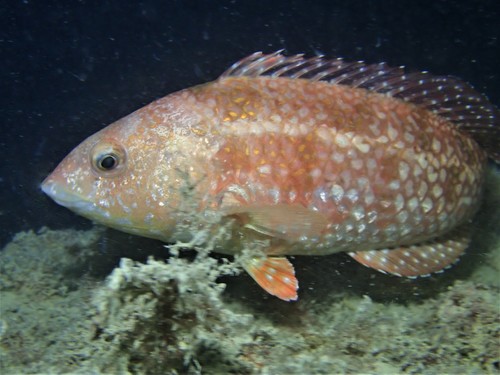
Notolabrus parilus, commonly called the brownspotted wrasse, is a relatively large wrasse species. The maximum recorded standard length of adult specimens is 31.2 centimetres (12.3 in). Male brownspotted wrasses have a dark brown or greyish-brown base body color, with an interrupted horizontal white band that runs the full length of the body. Their scales also have gold or brown markings. Females and juveniles have a lighter brown base color than males, or may be greenish; they have white blotches on their scales, and grey and brown vertical barring across their bodies.
Notolabrus parilus was first formally described in 1850 by Scottish naturalist John Richardson (1787–1865), under the original name Tautoga parila. The type locality for the species was given as King George Sound in Western Australia. Its specific name parilus comes from the name that Aboriginal inhabitants of the Port George Sound area used for this species.
The brownspotted wrasse is distributed along the Australian coastline from Shark Bay, Western Australia, around the southern coast of Australia as far east as southern Victoria. It is most abundant in Western Australia, particularly along the state’s southwestern coast. It is less common in South Australia, and Victoria marks the edge of its range where the species is very rare.
This wrasse occurs around rocky reefs that have seaweed growth, and it prefers sheltered, moderately exposed, or slightly more exposed locations. It is typically found at depths between 1 and 20 metres (3.3–65.6 ft), though it has been recorded at greater depths. Juveniles are sometimes found living in seagrass beds. The brownspotted wrasse is a carnivorous species that feeds on a variety of benthic invertebrates living in sandy substrates, seagrass, and seaweed. Its known prey includes gastropods, amphipods, isopods, prawns, crabs, and echinoids.
This species is a protogynous hermaphrodite, meaning all individuals start life as female and switch sex to male at some point during their life cycle. The sex change occurs when the fish reaches a standard length of 175–200 millimetres (6.9–7.9 in). Spawning happens from late Australian winter to early Australian spring. Eggs are laid in seagrass and reef habitats, and both eggs and larvae are pelagic.