About Notogrammitis billardierei (Willd.) Parris
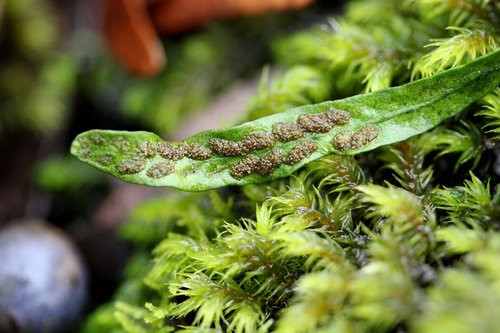
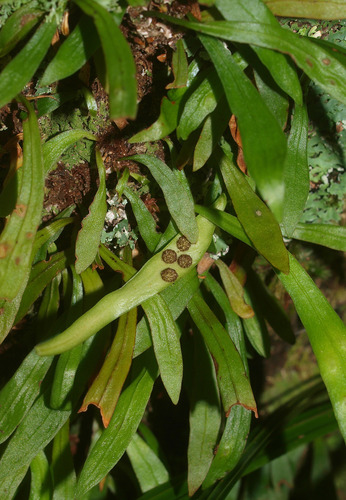
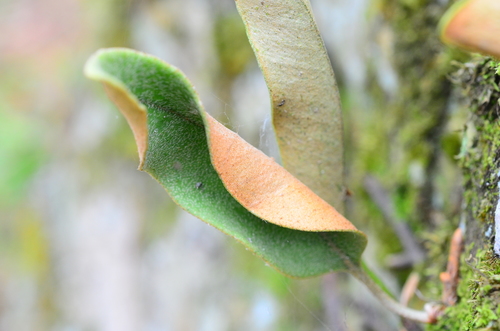
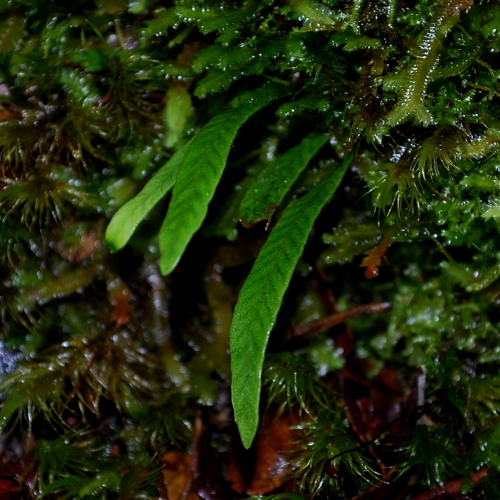
Notogrammitis billardierei is a small fern that typically grows on tree trunks, dead logs, and rocks. It produces leathery, dark green, narrow fronds that measure 7–15 cm long and 4–7 mm wide, with smooth entire margins and clearly visible midveins. Individual fronds are unbranching but grow crowded together, each sprouting directly from the plant’s rhizome. Its sporangia are grouped into oblong sori, unlike the more common circular sori found on many other ferns. These oblong sori lie at an oblique angle on either side of the midvein on the underside of each frond. As a member of the division Polypodiophyta, this species does not produce flowers, cones, or seeds, and reproduces sexually via spores. This fern is widespread in rainforest and moist open forest across Tasmania, New Zealand, and the eastern Australian coast in Victoria, New South Wales, and Queensland. It commonly grows on fallen trees and tree ferns, and can also grow on rocks and living trees. It requires moist, sheltered growing conditions, so it is far more common on southeast-facing hillsides than on northwest-facing hillsides. Cultivation of Notogrammitis billardierei is limited. It is generally not available commercially, and its epiphytic nature restricts the growing conditions it can be grown in. For successful cultivation, it must be handled delicately and kept consistently moist. The most common method of cultivation is to mount it epiphytically on a tree fern, such as Dicksonia antarctica.