About Notodonta ziczac (Linnaeus, 1758)
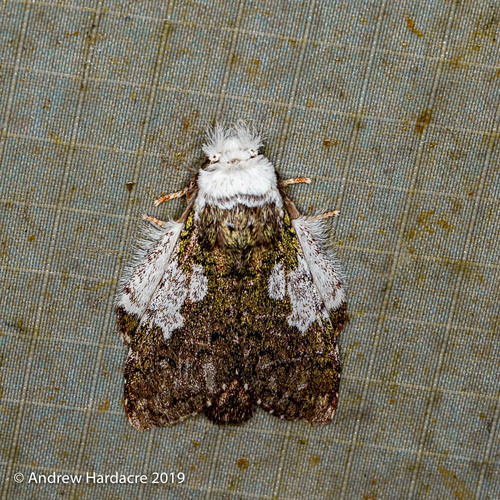
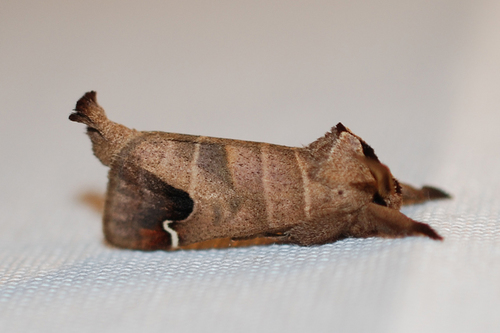
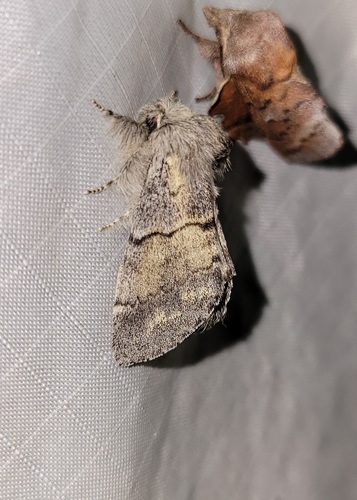
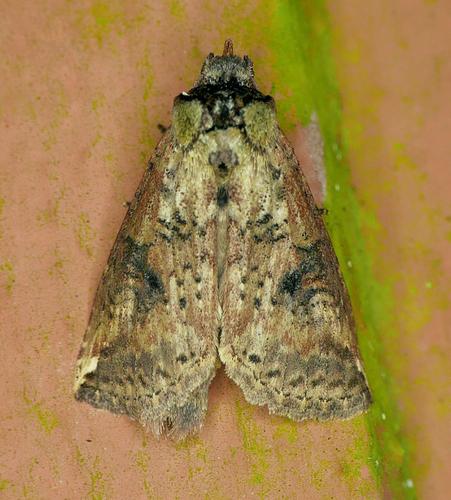
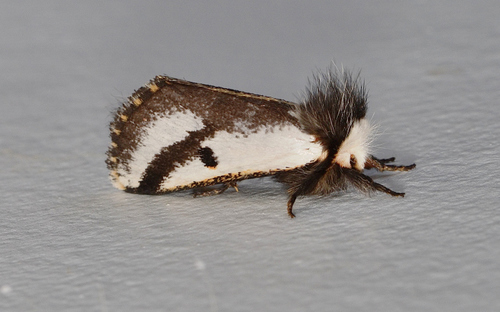
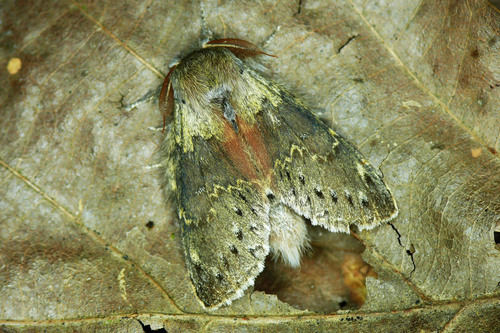
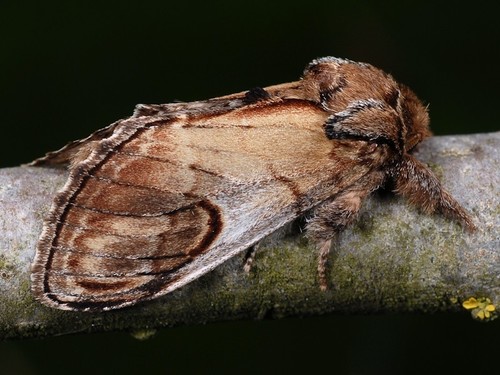
Notodonta ziczac (Linnaeus, 1758) has a wingspan of 40–45 mm. Its forewings are light grey along the front edge, with a cinnamon-brown inner portion. The grey area holds a roundish dark grey pebble-shaped stain, which is bounded proximally by a dark curved line. A dark, curved postmedian line runs toward the apex of the wing. The hindwings are grey, and darker grey in females, with a dark discal lunule. The thorax and abdomen are dark brown and densely covered in hair. According to Seitz’s description, the basal half of the forewing is light yellowish brown. The central costal area is white-grey, located between the dark transverse line and the large arcuate black discal spot. Beyond the discal spot sits a broad dark cloud, which is distally bounded by a pale dentate line. The marginal area contains a slightly undulate dark submarginal line, which has a pale distal edge and curves basad below the costal margin to form a black longitudinal stripe; the marginal line and hind margin are black. The hindwing is varying shades of greyish brown. Black markings on the forewing are sometimes dark brown, but never lighter than this. This species is found in Central and Northern Europe, extending south to Spain, Corsica, Central Italy, and the northern parts of Asia Minor. According to Graeser, it also occurs in Amurland. A pale subspecies, pallida subsp. nov. (45 g), found in Central Asia, has an ochreous forewing ground colour instead of brown. The egg of Notodonta ziczac is green. Larvae range in colour from pale red to violet, with a prominent tubercle on the second and third abdominal segments, and a dark dorsal line starting at the head, as seen in N. dromedaria. Both the tubercle and the dorsal stripe are edged with white. Darker individuals additionally have white spots and oblique stripes on the back, plus a white sideline at the level of the spiracles; this line is particularly distinct on the thorax. The larval head is narrow and high, with a rather deep incision at the vertex. Larvae can be found from June to July, and from August to October, feeding on Populus and Salix. The pupa is dark brown, with two anal points, and is enclosed in a hard cocoon located in or on the ground. Adults produce two broods per year, active from April to May and from July to August; only one brood is produced per year in the North.