About Notodonta dromedarius (Linnaeus, 1767)
Scientific name: Notodonta dromedarius (Linnaeus, 1767)
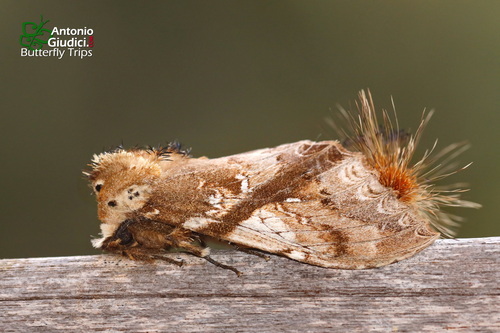
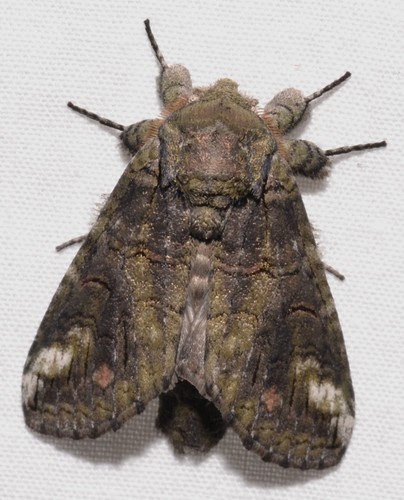
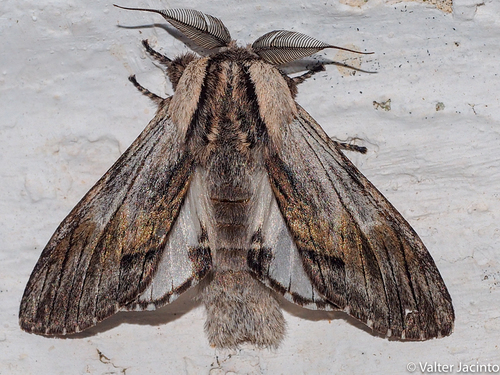
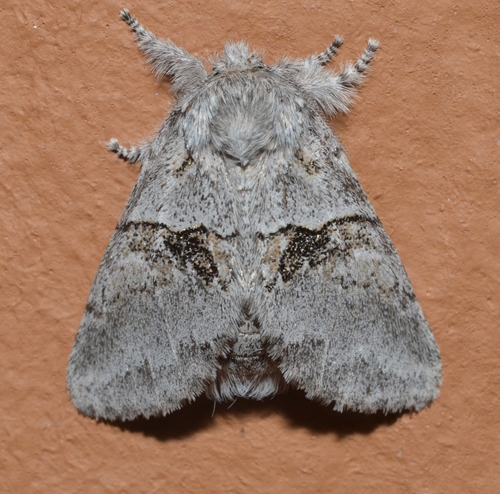
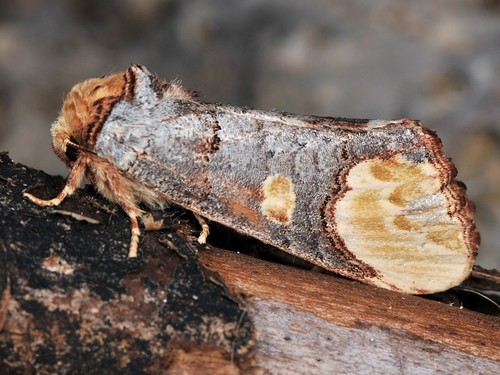
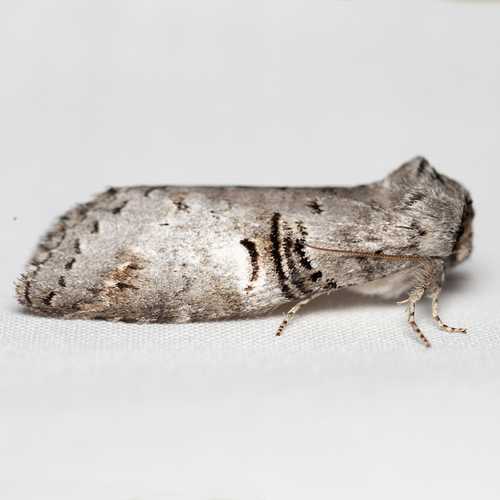
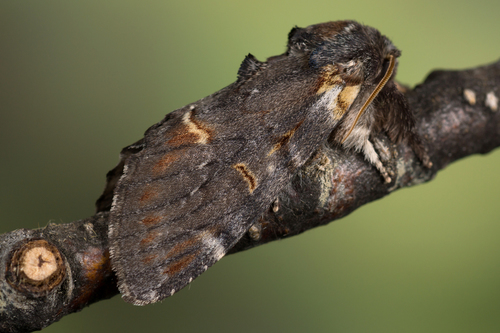
The wingspan of Notodonta dromedarius ranges from 35 to 40 mm. This moth has grey or dark brown forewings marked with rusty and yellowish stains. A broken rust-brown band runs along the outer edge of the forewing. There is a small discal spot, a postmedial crossline that is often broken, and outer margins suffused with dark red. Hindwings are usually pale grey-brown with dark veining. This species’ colouring is highly variable, and very dark specimens are known to occur.
In Seitz’s description: Forewings range from pale brownish grey to dark drome-grey-brown, with dark brown dentate pre- and postdiscal bands that have pale edges; the dark discal spot also has a pale edge. The marginal area is more or less distinctly rust-brown around a dark longitudinal streak, and the quite broad submarginal band is also bright rust-brown. The hindwing is grey-brown or predominantly grey. In specimens whose ground colour has faded with age or did not develop properly, the bright markings are very prominent. On the other hand, completely fresh specimens are almost uniformly black-brown, dark enough that markings are barely visible.
This species occurs in Central Europe, ranging north to Estonia and Livonia, south to Catalonia and Northern Italy, and also in Armenia; according to Graeser, it is also found in Amurland.
The larva is yellowish green or brown-red. In both colour forms, it has a dark red-brown dorsal stripe running from the head to the 4th abdominal segment. Each of the first to 4th abdominal segments bears a large dark red-brown tubercle. There is an interrupted dark longitudinal marking laterally above the legs. Larvae can be found from July to August, feeding on willow, birch, hazel and alder. The pupa is black-brown, and develops inside a cell in the ground. Adults fly in two broods: from May to June, and from July to August. Some pupae from the summer brood overwinter. Only one brood occurs in the Baltic provinces.