About Notobasis syriaca (L.) Cass.
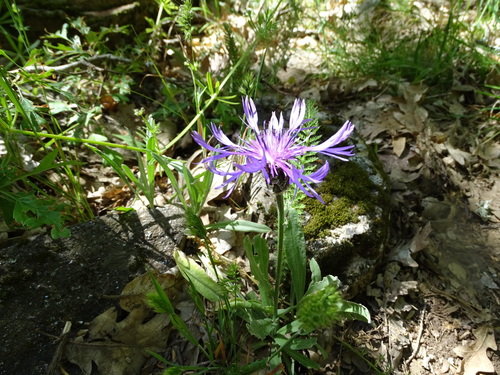
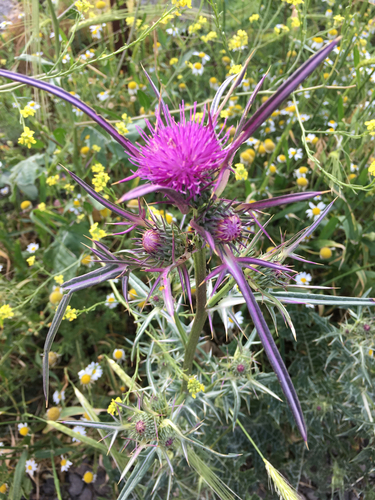
Notobasis syriaca, commonly known as the Syrian thistle, is a species of flowering plant. It belongs to the tribe Cardueae, which is part of the daisy family Asteraceae. This species is native to the Mediterranean region and the Middle East, ranging from Madeira, the Canary Islands, Morocco, and Portugal in the west, eastward to Egypt, Iran, and Azerbaijan. It is an annual plant that forms part of semi-desert flora, and grows to a height of 30–100 cm. Its leaves are arranged spirally on the stems, are deeply lobed, and coloured grey-green with white veins; sharp spines grow along the leaf margins and at the leaf apex. It produces purple flowers that form dense 2 cm diameter flowerheads, called capitula. These flowerheads are surrounded by several spiny basal bracts. On the Greek island of Crete, where the plant is called agavanos (αγκάβανος), local people peel its tender shoots and eat them raw. Notobasis syriaca is also naturalised in Australia.