About Notiomystis cincta (Du Bus de Gisignies, 1839)
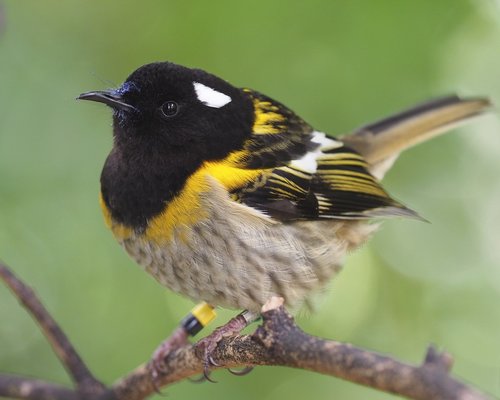
The stitchbird (Notiomystis cincta) is a small bird with a honeyeater-like appearance. Males have a dark velvety cap and short white ear-tufts that can be held slightly away from the head. A yellow band across the chest divides the black head from the grey rest of the body. Females and juveniles are duller in color than males, and do not have the black head or yellow chest band. The stitchbird has a rather thin, slightly curved bill, and a long tongue that ends in a brush, which it uses to collect nectar. Thin whiskers project outward and slightly forward from the base of the bill. Stitchbirds are very active and call frequently. Their most common call is a tzit tzit sound, which is widely thought to give the species its common name, as Buller noted that this sound "has a fanciful resemblance to the word stitch". They also produce a high-pitched whistle and an alarm call that is a nasal pek, similar to the call of a bellbird. Males produce a piercing three-note whistle, most often heard in spring, along with a range of other calls that females do not make. Research indicates that stitchbirds face interspecific competition from tūī and New Zealand bellbird. When these larger, more aggressive species are present, stitchbirds are forced to feed on lower-quality food sources. Stitchbirds rarely land on the ground, and seldom visit flowers on the large canopy trees that tūī and bellbird prefer, a pattern that may be a direct result of competition from these larger birds. Nectar is the main food of the stitchbird, but its overall diet includes over twenty species of native flowers, thirty species of fruit, and many species of introduced plants. Important natural nectar sources for the stitchbird are haekaro, matata, pūriri, rātā and toropapa. Its preferred fruits include Coprosma species, five finger, pate, tree fuchsia and raukawa. Stitchbirds also supplement their diet with small insects.

