About Notiochelidon cyanoleuca (Vieillot, 1817)
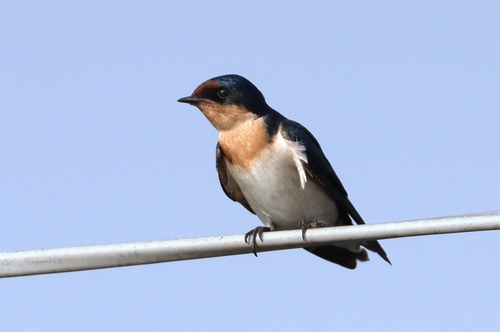
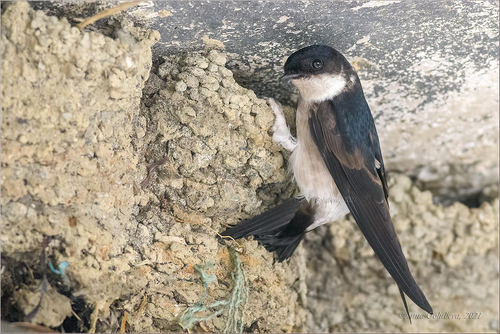
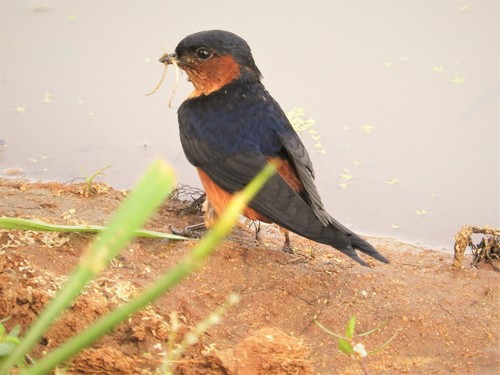
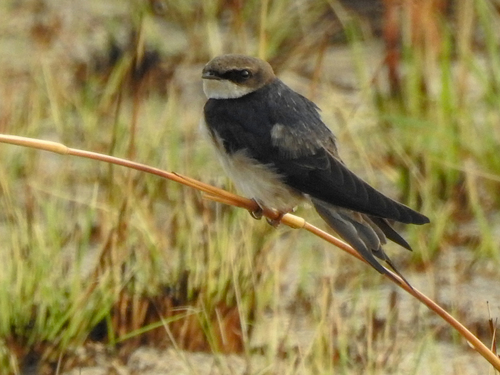
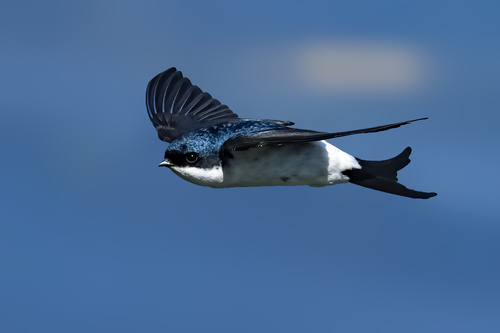
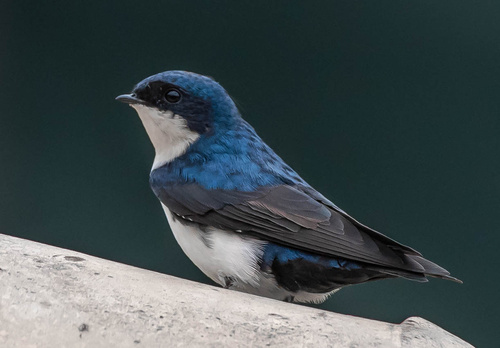
The adult blue-and-white swallow, scientific name Notiochelidon cyanoleuca, averages 11–12 cm (4.3–4.7 in) long and weighs about 10 g (0.35 oz). It has dark blue upperparts, white underparts, and blackish underwings and the undersurface of its short forked tail. Juveniles are brown above, buff-tinted below, and have a less forked tail. The call of this species is a buzzing dzzzhreeee. Three subspecies of Notiochelidon cyanoleuca are recognized. The nominate subspecies N. c. cyanoleuca ranges from Nicaragua and Trinidad south to northwestern Argentina, Paraguay and Uruguay. The migratory southern subspecies N. c. patagonica is larger at 13.5 cm (5.3 in), has paler underwings, and has white basal undertail coverts. N. c. peruviana is restricted to coastal Peru, occurring up to 2,500 m (8,200 ft) in altitude. It is smaller than patagonica, has less white in the undertail, darker underwings and duskier flanks. This swallow species occupies open areas including villages and towns, farms, and forest clearings. In Central America, it is a highland bird, but across the rest of its range it can occur from the lowlands to an altitude of 4,000 m (13,000 ft). When not breeding, this species is often found in small flocks. The blue-and-white swallow feeds primarily on insects that it catches in the air; individuals have been observed gathering at swarming termite sites. Its flight is typically fluttery, and this swallow frequently perches on wires or branches.