About Nothura maculosa (Temminck, 1815)
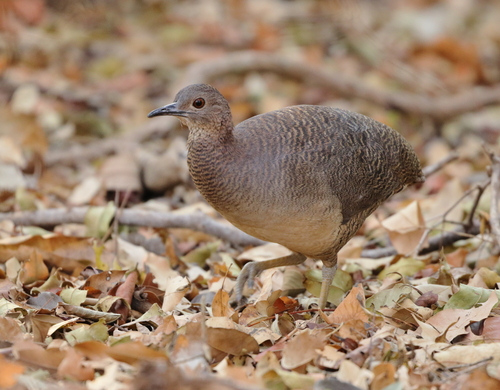
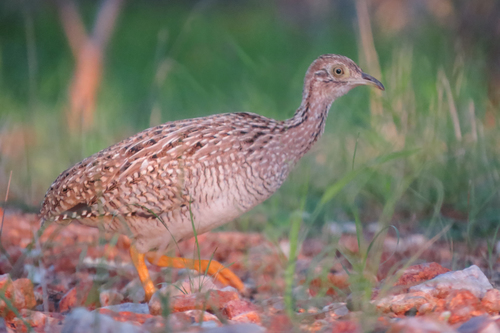
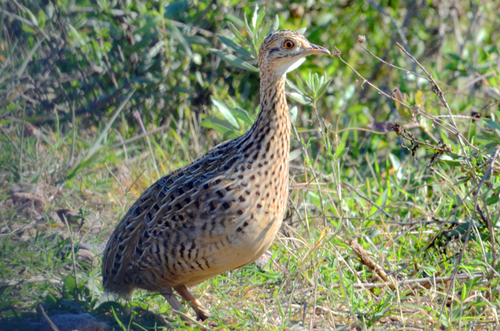
Nothura maculosa, commonly called the spotted nothura, measures approximately 24 to 25.5 cm (9.4–10.0 in) in total length. Its upper body is brown, marked with buff streaks. The underparts are buff, with black and brown streaking across the breast, and barring on the flanks. The species has a black crown streaked with buff, and a white throat. The overall color hue of the spotted nothura varies widely across its distribution range; this variation is partially caused by differences in local soil conditions. Along with its close relative the Chaco nothura (N. chacoensis), this species is one of only two nothuras that have barring on both webs of the primary feathers. Its legs are a dull yellowish-grey or brown color. This species occurs in eastern and southern Brazil, excluding the Mata Atlântica region and the planalto uplands along the Brazilian coast, as well as in Paraguay, Uruguay, and Argentina. It inhabits dry savanna up to 2,300 m (7,500 ft) in elevation, temperate grassland, and pasture land. The spotted nothura is capable of reproducing rapidly: females reach sexual maturity within 2 months and can produce five to six broods each year, while males mature more slowly. Males are responsible for incubating the eggs and raising the resulting chicks. Like most tinamous, this species produces eggs with a distinctive glossy, porcelain-like shell. In the spotted nothura, this shell is colored a rich maroon or chocolate brown. Clutches contain 4 to 6 eggs.