About Nothoscordum bivalve (L.) Britton
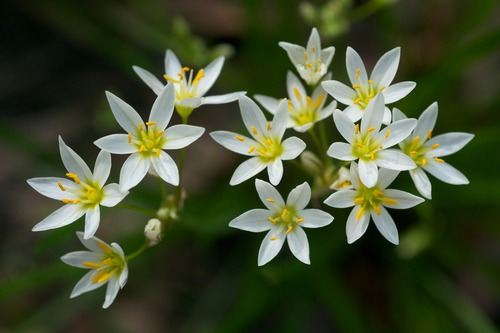
Nothoscordum bivalve is a perennial herb that grows from a bulb around 1 centimeter wide. It typically produces one erect stem, and occasionally two, reaching up to 40 centimeters (16 inches) in height. In 1896, Nathaniel Lord Britton published the following description of the species in *Illustrated Flora of the Northern United States, Canada, and the British Possessions*: "Bulb globose, less than 1' in diameter, its coats membranous. Leaves 1/2" - 2 1/2" wide, flat, blunt or acutish, shorter than the scape or equalling it; bracts of the umbel lanceolate, acuminate, membranous, persistent; umbel 6-12-flowered; pedicels filiform, usually unequal, becoming rather rigid and 1' - 2' long in fruit; flowers 5" - 6" long; perianth-segments thin, oblong-lanceolate, acute, longer than the stamens; capsule obovoid or somewhat depressed, obtusely 3-lobed, 2" - 3" high, the style as long or slightly longer." This species bears one to four narrow leaves that grow up to 30 centimeters (12 inches) long. Its inflorescence is an umbel holding 3 to 6 flowers, and sometimes up to 10 flowers. Two bracts grow at the base of the umbel. Each flower has six whitish tepals, most with a dark reddish midvein. The flower has no onion or garlic scent, and may carry a faint pleasant fragrance. Its fruit is a capsule. Regarding ecology and uses, the bulbs can be collected at any time of year and eaten cooked, with a faint garlic flavor. The USDA notes that Nothoscordum bivalve is grazed by livestock, but rarely makes up a large portion of livestock diets because of the species' low productivity. As one of the earliest blooming flowers in several southern U.S. states, it provides nectar and pollen for early spring active insects such as the falcate orangetip. Nothoscordum bivalve is currently being investigated as a potential antimicrobial treatment for antibiotic-resistant bacteria. Some Native American tribes have been reported to use this species to treat wounds and skin irritation to prevent infection, and it is thought to potentially have antimicrobial and astringent properties. No definitive findings confirming the species has antimicrobial properties have been published to date.