About Notholaena standleyi (Kümmerle) Maxon
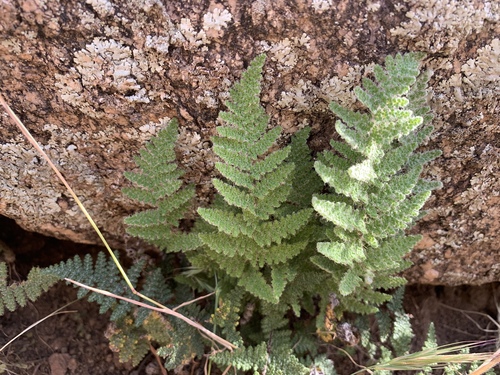
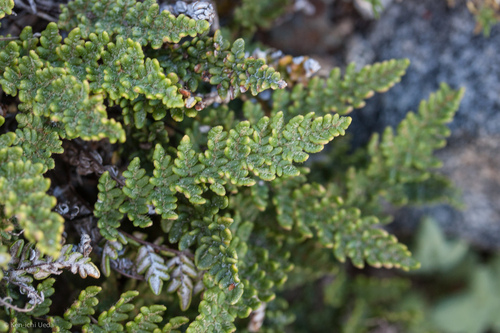
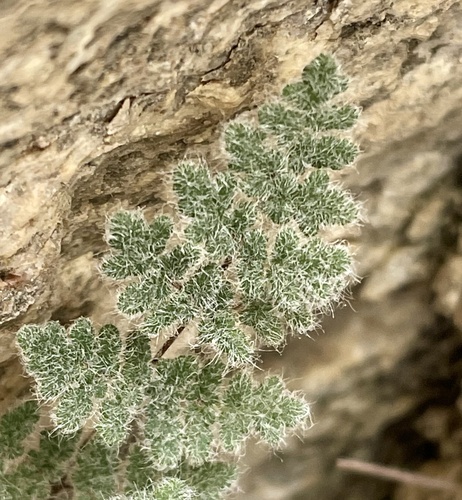
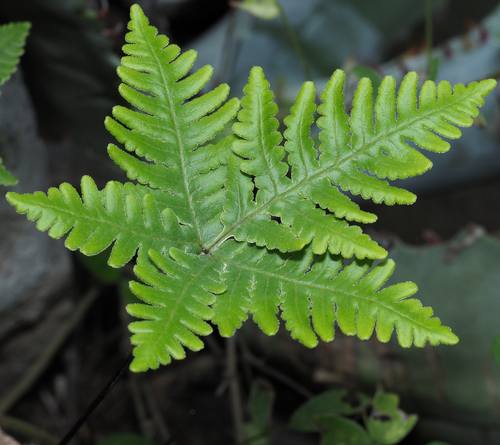
This species of fern, Notholaena standleyi, has brown petioles and green fronds. Individual plants grow erect, reaching a maximum height of 25 centimetres (9.8 in). Petioles grow between 5 to 13 centimetres (2.0 to 5.1 in) long. Individual fronds are typically 3 to 7 centimetres (1.2 to 2.8 in) in both length and width. Young fronds are light green, darkening to a deeper green as they mature. Most fronds have five blades arranged in a pentagonal shape. The blades are either bipinnately or tripinnately compound, and each is triangular with a pointed tip. The abaxial (lower) surface of the frond is covered in a powdery farina, whose function remains unclear. The color of this farina varies across geographically separated populations of the species; these distinct variants are called chemotypes, and there are four total chemotypes. Chemotypes also differ in their number of complete chromosome sets: gold and yellow farina chemotypes are diploid, while pallid and yellow/green farina chemotypes are tetraploid. The prothallus of Notholaena standleyi has glandular trichomes. Most sporangia of this species contain 32 spores, but many sporangia with only 16 spores have been observed, produced from eight 2n mother cells. The species is generally diploid, with 60 chromosomes present in root tip cells.
Notholaena standleyi is native to the southwestern United States and northern and central Mexico. In the United States, it occurs specifically in the states of Arizona, Colorado, New Mexico, Oklahoma, and Texas.
Notholaena standleyi is a perennial fern that most commonly grows in desert regions, at elevations ranging from 300 to 2,100 meters (980 to 6,900 ft). It grows on rocky hillsides, most often in crevices between limestone and granite boulders, which provide the partial shade this species prefers. As an adaptation to its semi-arid environment, fronds can curl and turn brown during drought, and recover once water becomes available. At lower elevations, it sometimes grows alongside the related species Notholaena californica. Its spores take 13 days to germinate, and it produces spores from late spring through fall. It follows the standard fern life cycle: the sporophyte produces haploid spores via meiosis, and these spores grow into haploid gametophytes. The gametophytes produce gametes via mitosis. After fertilization, the fertilized egg develops into a new sporophyte via mitosis. Spores are dispersed by air and water.