About Nothofagus solandri (Hook.f.) Oerst.
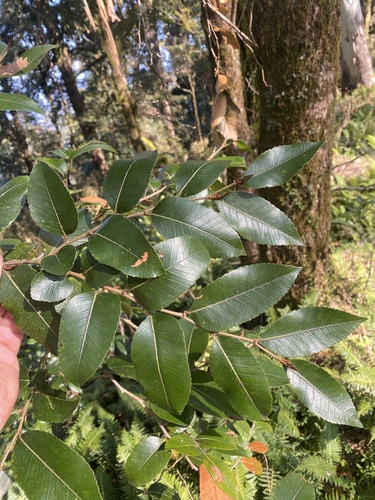
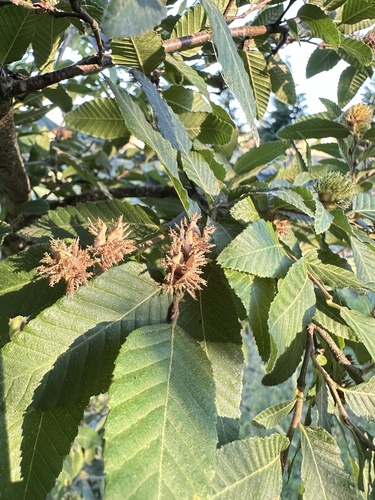
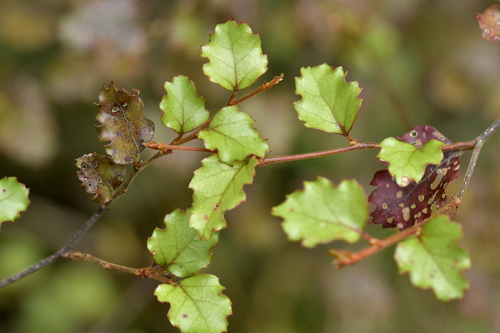
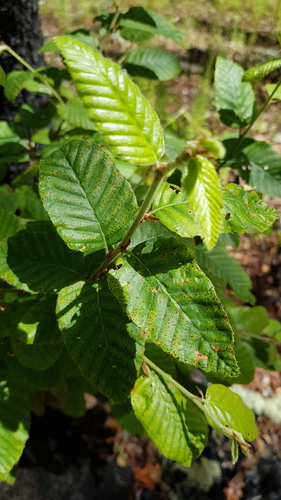
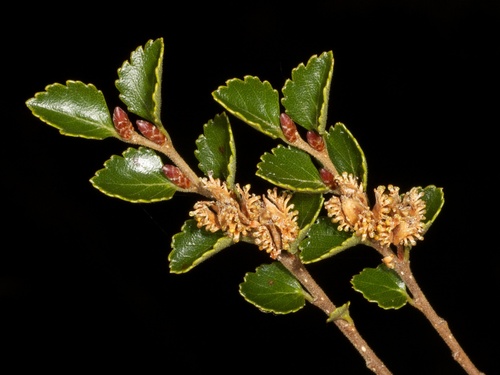
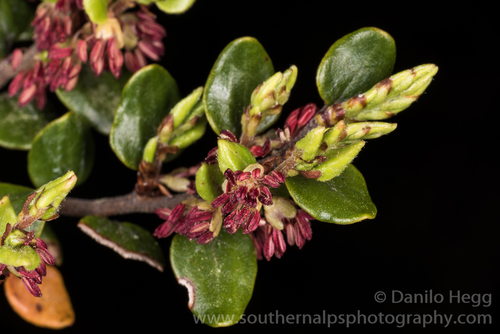
Nothofagus solandri (Hook.f.) Oerst., commonly known as black beech, with the Māori name tawai rauriki, is a tree species endemic to New Zealand. It is also classified as Nothofagus solandri var. solandri, and this taxon is often called Fuscospora solandri in New Zealand. Black beech grows on both the North Island and the South Island of New Zealand, ranging from low elevations up to mountain areas. It is a medium-sized evergreen tree that can reach 27 meters (89 feet) in height. Its leaves are oppositely arranged, ovoid in shape, 10 millimeters long and 5 millimeters broad, with smooth margins. The common name black beech comes from the sooty mold that frequently grows on the tree, covering its trunk and branches. This sooty mold develops because of scale insects that feed by sucking sap from the tree. The scale insects excrete sweet honeydew in small droplets, each less than 1 millimeter in diameter, that emerge from the end of stalks. This honeydew feeds the sooty mold, and also acts as a valuable high-energy food source for various birds and insects, including the kākā. This scale insect infestation is very common, and does not appear to cause harm to the black beech tree. The Māori names tawai rauriki and tawhai rauriki are also used for mountain beech, Nothofagus cliffortioides. Both black beech and mountain beech have been planted in Great Britain; in locations such as Scotland, mountain beech has demonstrated better cold tolerance than black beech.