About Notharchus tectus (Boddaert, 1783)
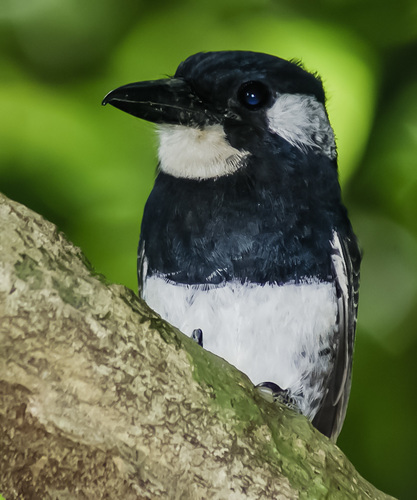
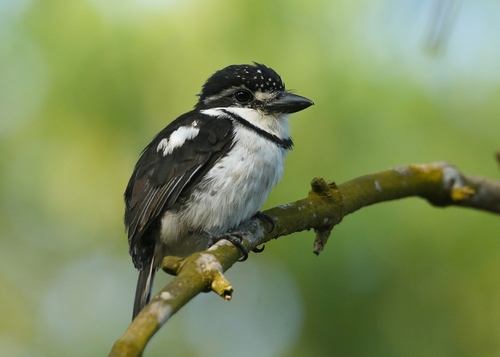
The pied puffbird (Notharchus tectus) is 14 to 17 cm (5.5 to 6.7 in) long and weighs 21 to 40 g (0.74 to 1.41 oz). The nominate subspecies is mostly glossy black on its upperparts and white on its underparts. It has a white stripe running from the bill through the eye, white speckles on the crown, a large white spot on the scapulars, and white markings near the base and at the tip of the tail. A broad black band divides the breast from the belly, and the flanks are barred black and white. Subspecies N. t. picatus is larger and darker than the nominate, with less white on the tail feathers. N. t. subtectus is smaller than the nominate, with a narrower breast band, less white spotting on the crown, and grayer flanks that have almost no white barring.
Three subspecies of pied puffbird each have separate distributions. The nominate subspecies occurs in southern Venezuela, the Guianas, and northern Amazonian Brazil, extending east to the state of Maranhão. N. t. picatus ranges from southeastern Colombia south through eastern Ecuador and Peru into eastern Bolivia, and east into west-central Brazil. N. t. subtectus is found from extreme southeastern Nicaragua through Costa Rica and Panama into north central Colombia, and through western Colombia into northwestern Ecuador. The species is generally resident across its range, but is thought to make some irregular seasonal movements.
The pied puffbird lives in a variety of landscapes, ranging from savanna to the interior and edges of tropical evergreen forest; other habitats it uses include secondary forest, gallery forest, abandoned clearings, and mangroves. It generally prefers the canopy and subcanopy. In Costa Rica, it appears to avoid primary forest, and occurs in more open landscapes up to 300 m (980 ft) in elevation. In other parts of its range, it occurs at elevations up to 1,000 m (3,300 ft).