About Notharchus hyperrhynchus (P.L.Sclater, 1856)
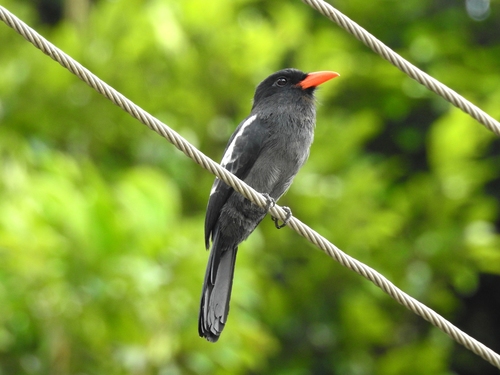
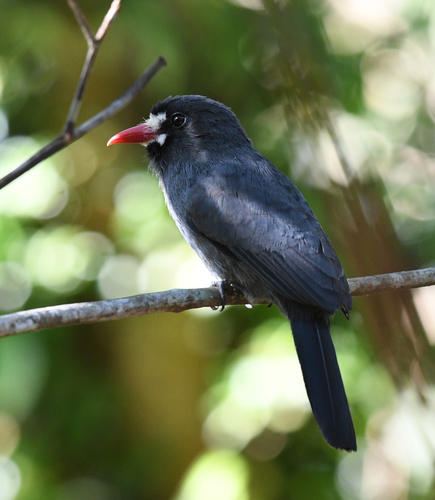
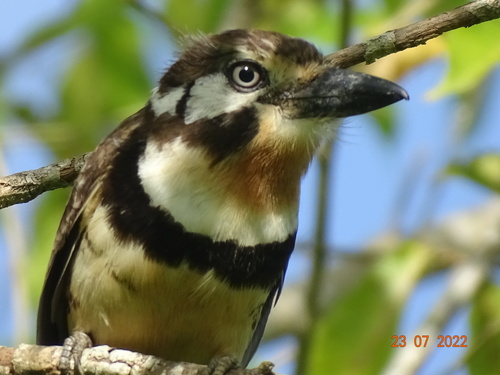
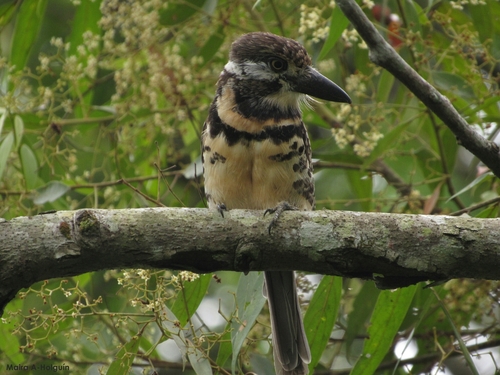
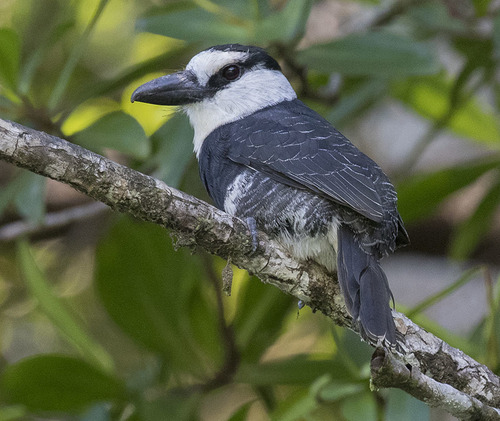
The white-necked puffbird (Notharchus hyperrhynchus (P.L.Sclater, 1856)) is about 25 cm (9.8 in) long and weighs 81 to 106 g (2.9 to 3.7 oz). Its plumage is mostly glossy black. It has a broad white forehead, throat, upper breast, and most of its belly. A broad black band separates the upper breast from the belly, and a black stripe runs from the beak through the dark red eye to the crown. The white coloration of the throat extends as a fairly broad line around the nape. The lower flanks have black and white barring, and the tail is black with narrow white feather tips. Its very large bill and feet are both black. The species' two subspecies differ only in bill length; the bill of N. h. paraensis is exceptionally long. The nominate subspecies has three distinct geographically separated populations: one ranges from southern Mexico through Central America into northern Colombia and northwestern Venezuela; one occurs in southwestern Colombia and western Ecuador; and one inhabits central Colombia, eastern Ecuador and Peru, northern Bolivia, and eastern Venezuela, extending south and east into most of Amazonian Brazil. N. h. paraensis is found only in the Amazon River valley of the Brazilian state of Pará, east of the Tapajós River. The species lives in a wide variety of landscapes. It occurs mostly in semi-open environments including secondary forest, primary forest edges, open woodlands, savanna, and clearings. It can also be found in the interior of tropical evergreen, semi-evergreen, and terra firme forest; on the landward side of mangrove forest; and in plantations. It can be found at all forest levels from the ground up to the canopy. In elevation, its range mostly extends from sea level to 1,200 m (3,900 ft).