About Notemigonus crysoleucas (Mitchill, 1814)
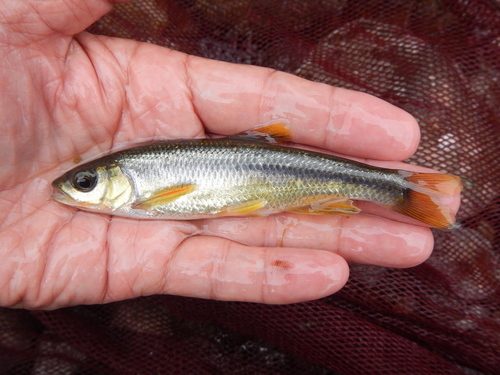
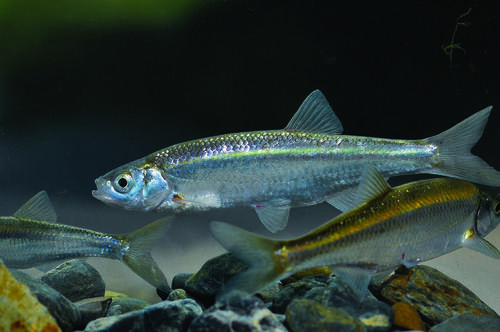
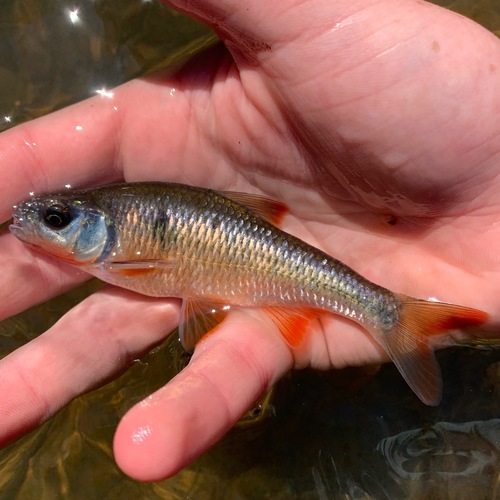
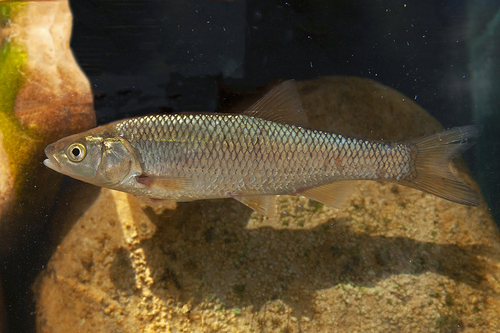
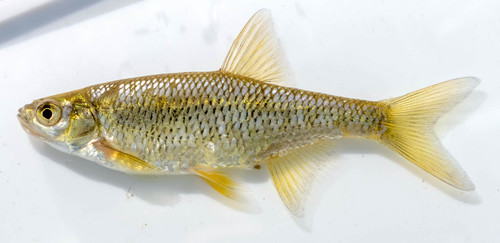
Description: While the largest recorded golden shiner (Notemigonus crysoleucas) reaches a total length (TL) of 36.7 cm (14.4 in), wild mature individuals are usually 7 to 20 cm (2.8 to 7.9 in) TL. Their bodies are laterally compressed, or deep-bodied. The back is dark green or olive, and the belly is silvery or brassy white. Smaller golden shiners have silver sides, a color that also appears in both clear and turbid water; larger individuals living in stained water have golden sides. A faint dusky stripe may run along the sides. The large anal fin has 8–19 rays, while the dorsal fin has 7 to 9 rays, most often 8. Adult golden shiners have relatively large scales that are easily lost when the fish is handled. They have a small, upturned mouth and yellow-green eyes. Their median and pelvic fins are also yellow-green, though spawning males may develop orange coloration in these fins, particularly on the distal leading rays. Two unique characteristics distinguish golden shiners from all other North American minnows. First, the lateral line has a pronounced downward curve, with its lowest point positioned just above the pelvic fins. Second, there is a scaleless fleshy keel on the belly between the pelvic fins and the base of the anal fin. This scaleless keel is key to telling golden shiners apart from the very similar-looking rudd (Scardinius erythrophtalmus), a European species introduced to a small number of locations in North America. Rudd also have a midventral keel, but their keel is covered in scales. Golden shiners and rudd can hybridize, and hybrids have a small number of scales on their midventral keel.
Distribution: The golden shiner is native to the eastern half of North America. Its native range extends north to the St. Lawrence River, Great Lakes, and Lake Winnipeg, west to the Dakotas and Texas, and south to southern Florida and Texas. Due to its widespread use as fishing bait, the golden shiner has been introduced to many locations outside its native range, especially in western North America.
Habitat: Golden shiners prefer quiet water, and are found in lakes, ponds, sloughs, and ditches. They sometimes occur in the slowest, quietest sections of rivers, and favor areas with abundant aquatic weeds. They are fairly tolerant of pollution, turbidity, and low oxygen levels. They can also tolerate temperatures as high as 40 °C (104 °F), which is unusually warm for a North American minnow.
Reproduction: In the southern parts of the golden shiner's range, individuals can begin reproducing at one year of age. In Canada, first breeding most commonly occurs at three years of age. Each female can lay up to 200,000 sticky eggs among aquatic vegetation. Golden shiners provide no parental care for their eggs or young. Occasionally, like some other minnow species, golden shiners deposit their eggs in the occupied nests of pumpkinseed, largemouth bass, or bowfin; the latter two species are predators of adult shiners. This behavior is called egg dumping, and it resembles the brood parasitism of birds such as cuckoos, because shiner eggs gain the benefit of the parental care the nest owner provides to the contents of its nest. Unlike cuckoo brood parasitism, however, the nest owner's own eggs are not harmed by the presence of shiner eggs, and may actually benefit from a dilution effect when predators attack the brood.