About Notamacropus rufogriseus (Desmarest, 1817)
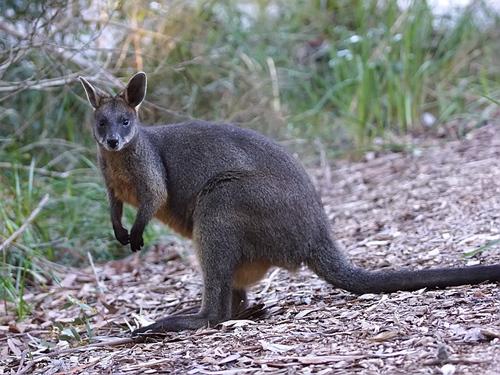
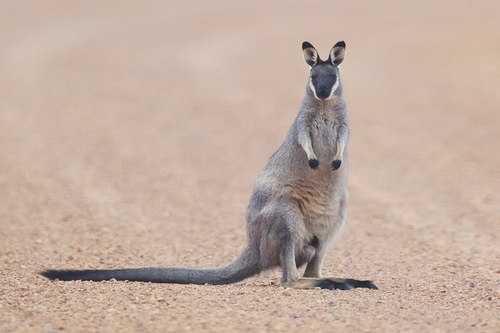
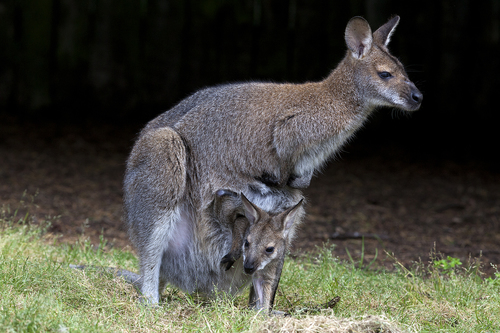
Red-necked wallabies (Notamacropus rufogriseus) can be identified by their black nose and paws, a white stripe on the upper lip, and a grizzled medium grey coat with a reddish tint across the shoulders. Adults weigh between 13.8 and 18.6 kilograms (30 to 41 lb), and reach a head-body length of 90 centimetres (35 in); males are generally larger than females. They are very similar in appearance to the closely related black-striped wallaby (Notamacropus dorsalis), but differ in being larger, lacking a black stripe running down the back, and having softer fur. Red-necked wallabies have a maximum recorded lifespan of nine years. This species inhabits coastal scrub and sclerophyll forest across coastal and highland eastern Australia, ranging from Bundaberg, Queensland, to the border of South Australia. It also occurs in Tasmania and on many Bass Strait islands, though it is unclear which of these Tasmanian island populations are native rather than introduced. Over the past 30 years, red-necked wallaby populations have expanded in Tasmania and coastal Queensland. This expansion is attributed to reduced hunting pressure, and partial forest clearing that has created a mosaic of night-time feeding pastures alongside day-time shelter bushland. For reasons that are not fully understood, the species is less common in Victoria.