About Northiella haematogaster (Gould, 1838)
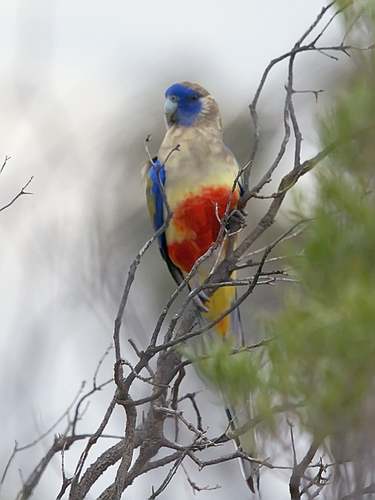
The eastern bluebonnet, with the scientific name Northiella haematogaster (Gould, 1838), is a medium-sized parrot that has prominent crest-like head feathers. All bluebonnets have upper bodies, forenecks, and breasts that are mostly olive-grey to brown. The outer wing and leading edge of the folded wing are dark blue, and the forehead and face are blue. Their bill is pearl grey, the cere is light grey, the iris is brown-grey, and the feet and legs are dark grey. There is no seasonal change to their plumage, and there are no other parrot species that look similar to the bluebonnet parrot. Body measurements differ by sex: males are 28–35 cm in body length with a 36–42 cm wingspan, while females are 26–32 cm in body length with a 34–38 cm wingspan. Weight for the species ranges from 70 to 100 grams. Each subspecies shows considerable geographical variation in both plumage and body size. Most subspecies differ in the amount of red on their underbody, and the pattern of their inner upperwing, which ranges from olive-yellow with a blue carpal patch and little to no red, to mostly red with a blue-green carpal patch. Below are descriptions of how each subspecies differs from the nominate subspecies. N. h. haematorrhous has red underbody colour covering the entire undertail and its covert area. On the folded wing, the shoulder patch is mostly red, and the leading edge around the carpal joint is a much lighter blue-green. N. h. haematogaster has yellow lower underparts with a variable amount of red on the abdomen, and a yellowish-olive wing patch. N. h. pallescens is paler than the nominate, with much less contrast between the breast and the pale yellow of the underbelly. The sexes differ slightly: adult females are a little duller in colour, and have less red on the belly than males. Females also often have a narrow off-white band across the underside of the inner primaries, though this feature is not always present. Juvenile eastern bluebonnets are similar to adult females, but are slightly duller and usually have even less red on the belly. The most distinctive feature of juveniles is their brownish-orange bill, which changes to the pearl-grey colour of adults within two months of fledging. Juveniles gain full adult plumage when they moult at around three to four months of age. Their calls include a harsh 'chack chack', a flute-like 'cloote', and a loud 'yak-yak-yak'. Bluebonnets are found in the interior of southeastern and central-southern Australia. Their range extends from northern Victoria to southern Queensland in the east, all the way across to southeastern Western Australia in the west. Each subspecies occupies a distinct separate area within the overall bluebonnet range: N. h. haematorrhous is found from southern Queensland to northern New South Wales; N. h. haematogaster ranges across western and southern New South Wales, and from northwest Victoria to southeast South Australia; N. h. pallescens lives in inland South Australia, within the Lake Eyre Basin. Bluebonnets inhabit arid and semi-arid zones of Australia. They live in open woodlands dominated by false sandalwood (Myoporum), belah (Casuarina cristata), native pine (Callitris), western myall, gidgee, mulga (Acacia), and Eucalyptus. These woodlands often have a low shrub layer made up of chenopods such as saltbush (Atriplex) or blue bush (Maireana). Bluebonnets also inhabit open grassy plains, scrub, and trees growing alongside watercourses. Remnant patches of mallee in northern Victoria are important habitat for bluebonnets in the southern part of their range.