About Norrisia norrisii (G.B.Sowerby I, 1838)
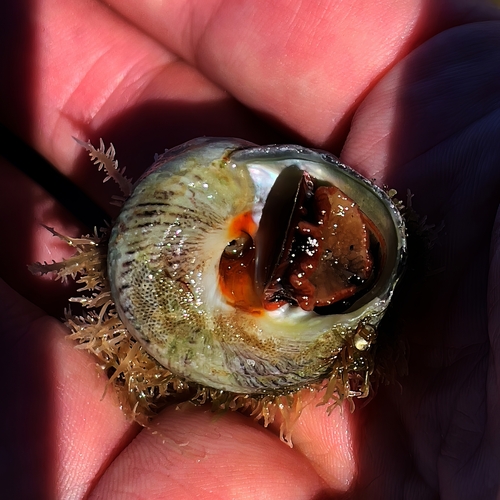
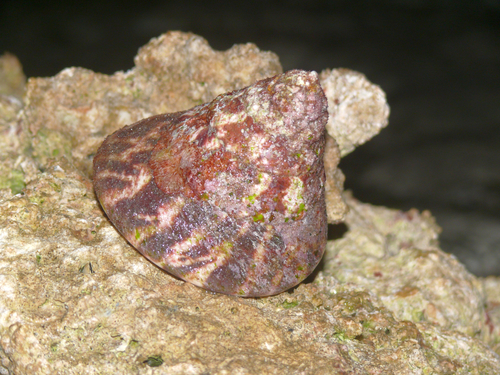
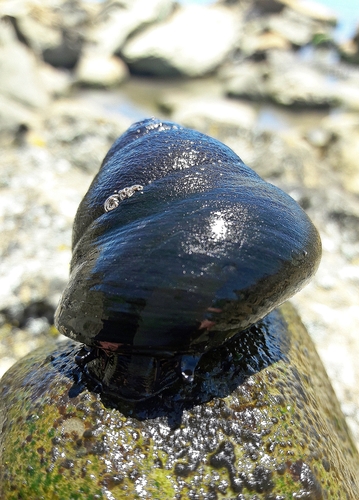
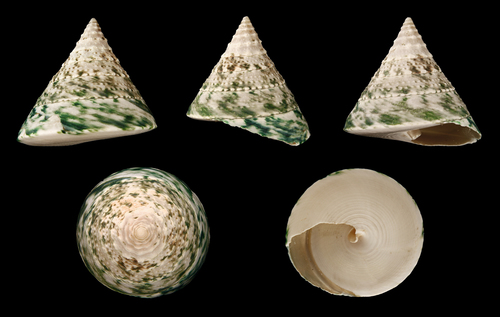
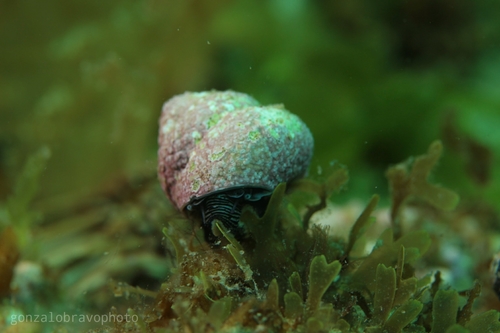
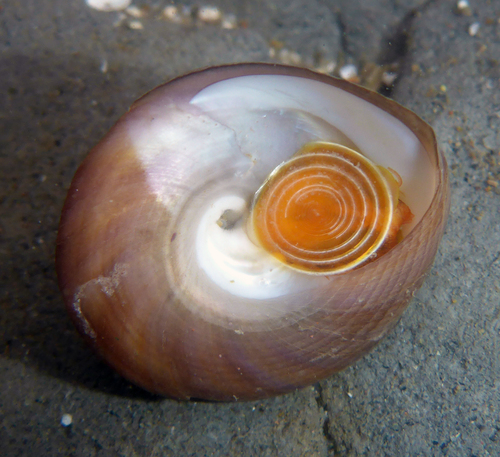
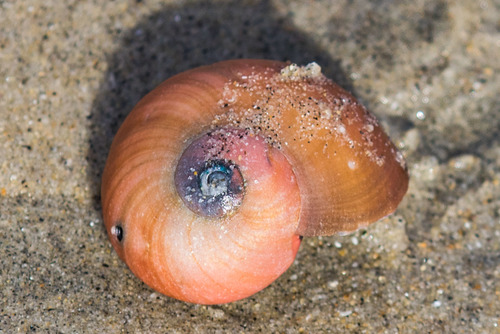
Norrisia norrisii (G.B.Sowerby I, 1838) has a wide, solid shell. Juvenile shells measure a few millimeters across their greatest dimension, while full adult shells reach up to 59 mm across this same measurement. The shell is mostly smooth, with only faint growth lines and unclear spiral lines. Its external color is brown or reddish fawn, it is black around the umbilicus, and the inner shell surface is greenish. Like other trochid snails, including the more common Chlorostoma (or Tegula) species, the dextrally coiled shell of Norrisia norrisii is globose with a depressed-turbinate shape. The spire is low-conoidal. The tiny apex is subacute, with spiral striae; when intact, the apical whorls are variegated. The species has 6 whorls that widen rapidly, are nearly flat and sloping on their upper surface, have edges that project outward, and are finely textured and rolled like a spiral cord. The body whorl is very large. The sutures are plain, and the thin peristome is simple. Other distinct features include a smooth green columella, and an open umbilicus surrounded by a black ring. The columellar margin is thickened at the base of the shell, and bears a very obtuse tubercle at this position. The aperture is rounded-quadrangular, angular at the top, and brightly nacreous on the inside. The aperture is closed by an operculum made of protein rather than calcium carbonate; this operculum is circular, multispiral, and has a central nucleus. The fleshy foot of the snail is bright reddish orange, with black speckling along its basal margin. Four elongated epipodial tentacles are spaced evenly along each side of the muscular foot. Empty shells of Norrisia norrisii are often occupied by hermit crabs, which use the hard shell to protect their soft, poorly armored posterior bodies. This species is found along the Pacific coast of North America, ranging from Monterey, California, south to Isla Asuncion on the Baja California peninsula of Mexico. Off the coast of California, Norrisia norrisii primarily occurs south of Point Conception in the low intertidal and shallow subtidal zones; the only persistent population found north of Point Conception is in Diablo Cove. Norrisia norrisii inhabits the lower rocky intertidal zone, where it grazes on algae, microscopic films, and wrack. It is more commonly found in the shallow subtidal, especially in kelp forests. Off the coast of southern California, on Santa Catalina Island, Norrisia norrisii is commonly seen crawling up and down the stipes of giant kelp, Macrocystis pyrifera. Very little is known about the reproduction of Norrisia norrisii. Some marine snail species use broadcast spawning, releasing both sperm and eggs into the water column for external fertilization, while others use internal fertilization of eggs before releasing larvae or laying egg cases that hold developing larvae. It is currently unknown which reproductive method Norrisia norrisii uses.