About Nonnula rubecula (von Spix, 1824)
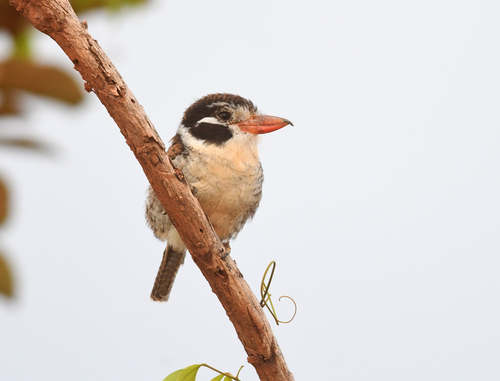
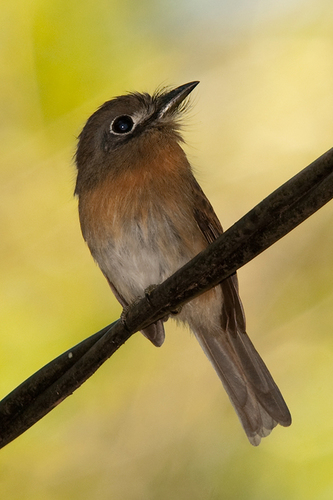
The rusty-breasted nunlet (Nonnula rubecula) is 14 to 16 cm (5.5 to 6.3 in) long and weighs 17 to 20 g (0.60 to 0.71 oz). Its subspecies differ from each other in structure and color. In general, more northerly subspecies have longer, narrower bills and shorter tails than more southerly subspecies. The nominate subspecies has two or three distinct color morphs. Some nominate individuals have plain dark gray-brown upperparts and wings. They have rufous lores, a whitish band extending from the lores that connects to a white ring around the eye, and a dark brown tail. Their throat, breast, and flanks are brown with a reddish tinge, and their abdomen is whitish. Other nominate individuals are paler and grayer, especially on the crown; individuals in the southeast are darker brown with a warmer brown tail. Some individuals have bright orange-rufous throat, breast, and flanks instead of brown. Subspecies N. r. tapanahoniensis has a very gray crown and a cinnamon tinge on the vent. N. r. duidae has a rufous chin. N. r. interfluvialis has a grayer tail, while N. r. simulatrix has a darker tail than the other subspecies. N. r. simplex is drab and dark, and N. r. cineracea has warmer brown underparts. The rusty-breasted nunlet is found in two separate disjunct ranges, with its subspecies distributed as follows: N. r. tapanahoniensis occurs in the southern Guianas and northern Brazil west of the lower Amazon River, and is considered hypothetical in French Guiana; N. r. duidae occurs in eastern Venezuela north of the Orinoco River; N. r. interfluvialis occurs in southern Venezuela and northern Brazil between the Orinoco and Negro rivers; N. r. simulatrix occurs in southeastern Colombia and northwestern Brazil between the Negro and Amazon rivers; N. r. cineracea occurs in northeastern Ecuador, northeastern Peru, and western Brazil south of the Amazon; N. r. simplex occurs in northern Brazil south of the lower Amazon; the nominate subspecies N. r. rubecula occurs in eastern and southeastern Brazil, eastern Paraguay, and northeastern Argentina. The rusty-breasted nunlet primarily lives in humid terra firme and várzea forest, and is also found in secondary forest and forest edges. It can occur at any level of the forest interior but is most often found in the midstory. In Venezuela it is usually found in sandy soil areas; in Paraná state of southeastern Brazil it occurs in gallery forest, and it avoids igapó forest in upper Amazonia.