About Nomascus leucogenys (Ogilby, 1840)
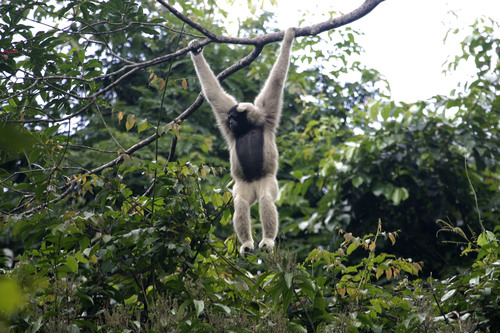
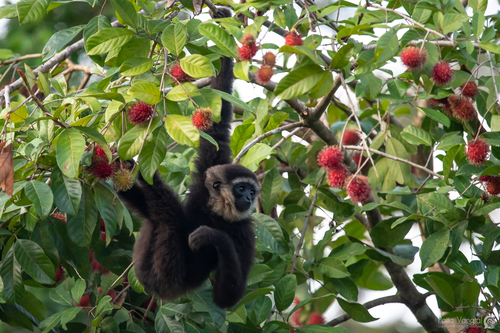
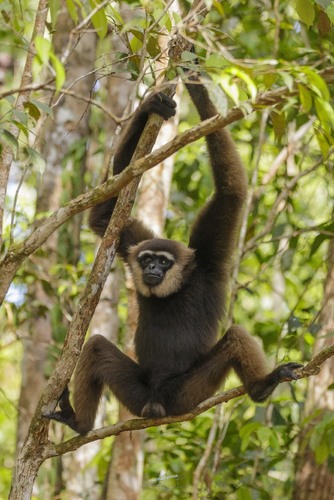
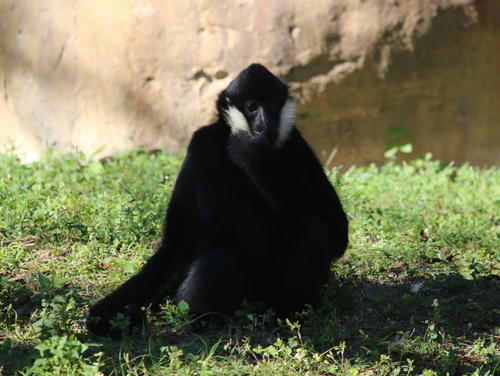
Northern white-cheeked gibbons (Nomascus leucogenys) are sexually dimorphic: males and females have different fur colouration, and males are also slightly larger. Males have entirely black body hair, distinct white cheek patches, a prominent hair tuft on the crown of the head, and a gular sac. Females have reddish-tan fur, lack a cranial tuft, and have a crest of black or dark brown fur that runs from the crown to the nape of the neck. The species has a reported average weight of 7.5 kg (17 lb), but this measurement comes from only a small number of wild individuals, and captive individuals tend to be larger. Like other members of their genus, both males and females have unusually long arms even for gibbons, with arms 1.2 to 1.4 times the length of their legs. They are also more muscular, with heavier thighs and shoulders that indicate greater bodily strength. Adult individuals show hand preference when swinging through trees, and individuals are equally likely to be right-handed or left-handed. This species closely resembles the southern white-cheeked gibbon, but has slightly longer body hair and subtly different vocalizations. Males of the two species can also be told apart by the shape of their white cheek patches: in northern white-cheeked gibbons, the patches reach the upper borders of the ears and do not touch the corners of the mouth, while in southern white-cheeked gibbons, the patches only reach halfway up the ears and entirely surround the lips. Both male and female northern white-cheeked gibbons produce reddish-brown secretions from glands around their upper chest, hips, and ankles. However, steroid levels in sweat samples taken from the axillae and chest are lower in white-cheeked gibbons than in many other ape species, which suggests olfactory signals may be less important for these animals than for their relatives. Today, the northern white-cheeked gibbon is found only in northern Vietnam and northern Laos. It was formerly present in southern China’s Yunnan province, where it was reported to be on the edge of extirpation in 2008, and was confirmed extinct in China in 2013. In 2019, a population of 57 gibbon groups was estimated at the Nam Et-Phou Louey National Protected Area in Laos. In northern Vietnam’s Pù Mát National Park, located in Nghệ An Province near the Laos border, at least 22 groups of N. leucogenys have been confirmed. In 2020, the Center for Nature Conservation and Development confirmed a population of 64 groups and 182 individuals in Vietnam’s Xuan Lien nature reserve in Thanh Hoa province, following a two-year gibbon monitoring program. This count represents a significant increase from the 2011 baseline data of 41 groups and 127 individuals recorded at the site. No subspecies are currently recognised, though the southern white-cheeked gibbon was formerly classified as a subspecies of N. leucogenys. Northern white-cheeked gibbons inhabit primary evergreen subtropical forest at elevations between 200 and 1,650 metres (660 and 5,410 ft). Northern white-cheeked gibbons are monogamous, with long-lasting pair bonds. Their ovarian cycle has an average length of 22 days, and gestation lasts between 200 and 212 days. At birth, individuals of both sexes are covered in yellow-buff fur and have an average weight of 480 g (17 oz). Around one year of age, the fur of both sexes changes to black with pale cheek patches. Sexually dimorphic adult fur only grows when individuals reach four or five years of age. During this juvenile period, young gibbons sing the female form of the call and regularly engage in play behaviour. Northern white-cheeked gibbons reach sexual maturity at seven or eight years of age, and have been recorded living for at least 28 years in the wild.