About Nolina microcarpa S.Watson
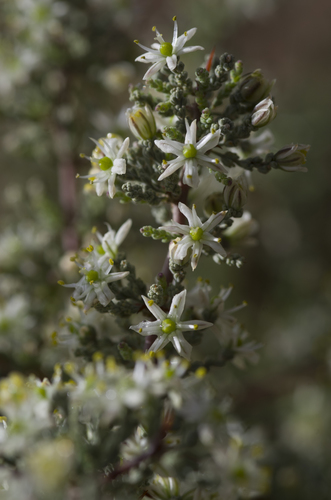
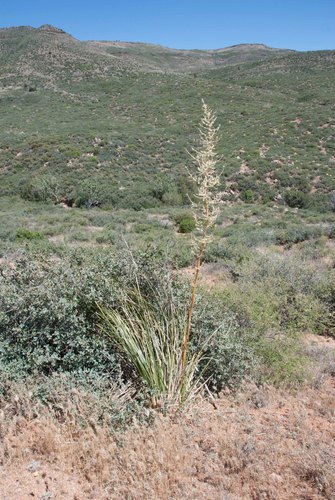
Nolina microcarpa is a species of flowering plant in the asparagus family, with the common names sacahuista and palmilla. Like other Nolina species, it may also be called beargrass. It is native to northern Mexico and the southwestern United States, specifically Arizona and New Mexico. It has a limited distribution on Navajo Sandstone in the southwestern corner of Utah, but reports of it growing in Texas are likely incorrect. Sacahuista varies in appearance. Generally, it is a large plant that grows in clumps up to two meters wide. It forms a rosette of many narrow leaves, each reaching up to 130 centimetres (4.3 feet) long and only 1.2 centimetres (0.47 inches) wide. These grasslike leaf blades are thick, rough, and serrated. The plant has no aboveground stem; all leaves grow from a woody underground caudex. When flowering, it produces a scape that is 1.5 to 1.8 m (4.9 to 5.9 ft) tall. The inflorescence is a panicle of flowers that have tiny white tepals. This species is dioecious, meaning male and female flowers grow on separate individual plants; occasionally, flowers with both fully functional male and female parts occur. Its fruit is a papery, three-sided capsule that is roughly half a centimeter long and wide. This plant grows in dry habitat types, including desert grasslands, pinyon-juniper woodlands, and chaparral. It is a dominant plant species in many ecosystems, and often grows alongside oaks, pines, and manzanitas. Its native region has a bimodal precipitation pattern, with rainy seasons from November to April and a second rainy season in summer. Wildfire is common in this area; Nolina microcarpa resprouts from its caudex after its aboveground parts are burned. Sacahuista herbage is flammable, and increases the local intensity of fires when it catches fire. Sacahuista provides food for animals such as white-tailed deer. However, it is poisonous to sheep and goats, and less toxic to cattle. Sheep fed parts of the plant have been recorded to develop rumen impaction and liver toxicity. In experimental settings, the plant is also toxic to rats and chukar partridges; ingesting its seeds causes symptoms including loss of coordination and diarrhea. Humans can eat this plant. Native American groups have eaten its fruit, used its stalks as a vegetable, and ground its seeds into flour to make bread. The plant has also been used to make thatching, mats, baskets, brushes, rope, and cooking tools. In modern times, it is used for landscaping in climates that suit it.