About Nolina brittoniana Nash
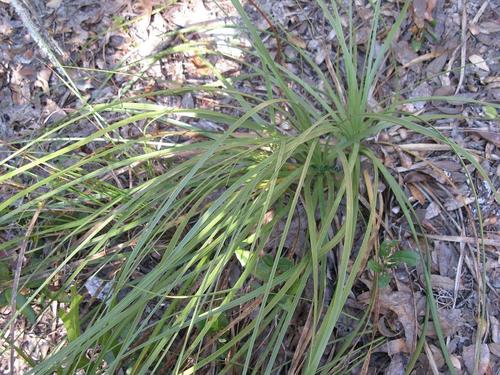
Nolina brittoniana, commonly called Britton's beargrass, is a rare flowering plant in the asparagus family. It is endemic to Florida, where 72 populations are known to exist, and only a small number of these populations are large enough to be considered viable. It is federally listed as an endangered species in the United States. This species has no aboveground stem. It forms a rosette of leaves connected to a bulblike base that grows from an underground caudex, which is a modified stem. Its grasslike leaves can reach up to one meter in length, and rarely grow more than one centimeter wide. The leaf edges are serrated with hard, cartilaginous teeth. The inflorescence is a large, erect panicle that grows up to one meter tall, bearing small bracts and reduced leaves. Its many small flowers have tepals that measure just 1 to 2 millimeters long. Though the flowers are structurally bisexual, they are functionally unisexual: either the male or female reproductive structures are reduced and non-functional. Most individual plants produce only functionally male or only functionally female flowers, but some plants produce both types. Blooming occurs from March through May. After flowering, the plant produces winged capsules that are roughly one centimeter long and one centimeter wide. This species can reproduce sexually via seeds, and also reproduces vegetatively through cloning. Nolina brittoniana is found only in seven counties of Central Florida, where it grows in several distinct habitat types. It occurs in various forms of Florida scrub habitat, hammocks, and sandhills. While these habitat types differ in many characteristics, they all share dry, well-drained, low-nutrient sandy soils, and all are naturally maintained by wildfire. This species occurs on the Lake Wales Ridge, an area that hosts many rare plant species endemic to Central Florida. It grows alongside a number of other rare local endemics: Polygala lewtonii, Polygonum dentoceras, Polygonum basiramia, Paronychia chartacea subsp. chartacea, Persea humilis, Liatris ohlingerae, Hypericum cumulicola, Conradina brevifolia, Calamintha ashei, and Bonamia grandiflora. This beargrass is more widespread than many other rare local plants, but most of its populations are small, and some populations consist entirely of female individuals. Like other members of its native plant communities, this species depends on a natural fire regime. Periodic wildfire stops large woody vegetation from encroaching on the habitat, halts ecological succession, and keeps the canopy open enough to allow sunlight to reach the lower herb layer. Today, most of these fire-maintained Florida habitats are degraded due to long-term fire suppression policies. Habitats become overgrown, with dense canopies and large accumulations of flammable organic material. Without regular fire, Britton's beargrass grows poorly, has inefficient reproduction, and populations experience very low recruitment of new individuals. This species produces the most flowers in the year after a wildfire. Many populations are located on privately owned land, so whether controlled burns are carried out depends on individual landowner decisions. Additional threats to the species include habitat loss from residential development and agricultural operations, especially the establishment of citrus groves, as well as habitat fragmentation. However, the species has likely always occurred as sparse, scattered populations even before human disturbance to its habitat, so conservation of remaining habitat fragments is expected to be sufficient to maintain the species. Prescribed controlled burns should be a key part of this conservation strategy. Though rare in the wild, Britton's beargrass is cultivated in plant nurseries.