About Nolina beldingii Brandegee
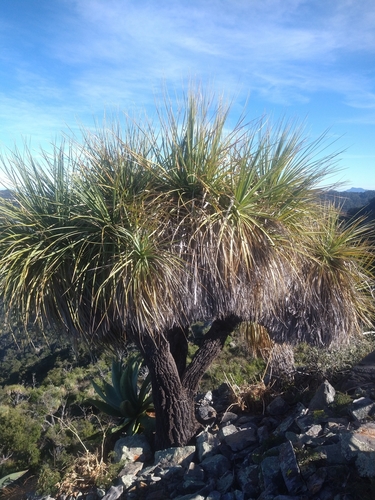
Nolina beldingii Brandegee is an arborescent Nolina species that reaches 5–7 meters (16–23 feet) in height, with a trunk that reaches 50 centimeters (20 inches) in diameter. Its bark is fissured, forming rectangular blocks 10 to 25 centimeters (3.9 to 9.8 inches) long with 5-centimeter (2.0-inch) deep ridges. Young bark is gray, and it turns maroon as it ages. The apex of its trunk or trunks holds 1 to 26 leaf rosettes; each rosette is 1–3 meters (3.3–9.8 feet) in diameter, and retains old persistent leaves along the trunk. The leaves are long, narrow, and linear, measuring 0.75–1.15 meters (2.5–3.8 feet) long and 1.4–2.0 centimeters (0.55–0.79 inches) wide at their midpoint. They are dark green, smooth, and sometimes become reddish toward the back. The sides of the leaf tip are smooth, but the rest of the leaf margins are dentate, bearing small teeth 0.2 millimeters (0.0079 inches) long. Its inflorescence is paniculate, 2–3 meters (6.6–9.8 feet) long and 20–70 centimeters (7.9–27.6 inches) in diameter. The 1-meter (3.3-foot) tall scape is smooth and bears linear-shaped bracts. The inflorescence branches are lax, loose, open, and curved to undulate; lower branches reach 23 centimeters (9.1 inches) long, while branches toward the inflorescence tip reach 15 centimeters (5.9 inches) long. Staminate flowers are campanulate in shape, 4–6 millimeters (0.16–0.24 inches) in diameter, and grow on pedicels 2.5–3 millimeters (0.098–0.118 inches) long. Pistillate flowers are also campanulate, growing on pedicels 4–8 millimeters (0.16–0.31 inches) long, and are colored light yellow to cream with a reddish midvein. The fruits of this species are 1.4–1.5 centimeters (0.55–0.59 inches) wide. This species is endemic to the Sierra de la Laguna, a mountain range in the Cape region of Baja California Sur, Mexico. It grows on granitic outcrops at elevations between 1,000 meters (3,300 feet) and 1,800 meters (5,900 feet), often in the highest mountain reaches. It occurs predominantly on steep slopes and cliffs in local oak and pine forests, growing alongside Quercus tuberculata, Q. devia, Q. arizonica, Arbutus peninsularis, and the rare Dudleya rigida. Brandegee, the species' original author, described it as "the most striking part of the vegetation" among the area's oaks and pines. Local peoples reportedly use the leaves of this species for thatching. Members of the genus Nolina are also used by indigenous peoples to make mats, basketry, and hats. In parts of Arizona, New Mexico, Sonora, and Chihuahua, the leaves of other Nolina species are used to make brooms.