About Nodobryoria abbreviata (Müll.Arg.) Common & Brodo
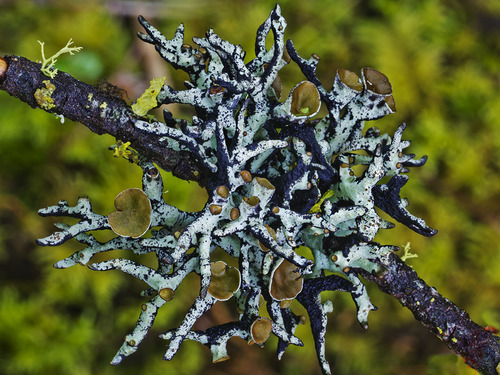
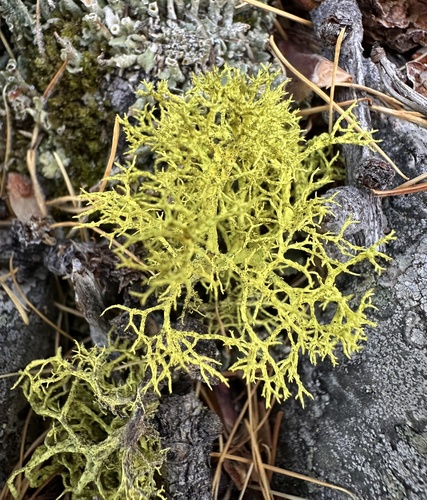
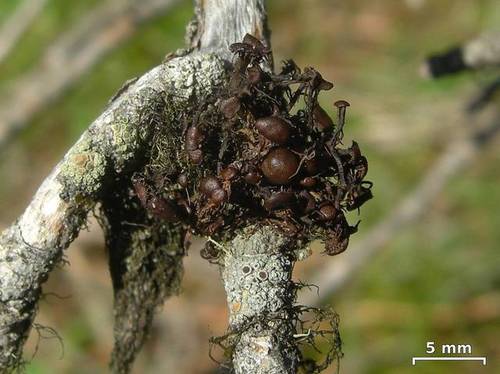
Nodobryoria abbreviata, scientifically named (Müll.Arg.) Common & Brodo, has a reddish brown, tufted thallus that forms erect to somewhat erect strands reaching around 3 cm long. Its branches are round to somewhat angular in cross-section, and often look finely spiny because of short, pointed lateral branchlets. This species has no pseudocyphellae, soralia, or isidia. Apothecia are usually absent; when present, their margins may bear cilia. Standard spot tests give negative results across the entire thallus. Branches are reddish-brown to dull chestnut in color, and often become brittle when dry. They are typically thin, repeatedly branched, and may become somewhat flattened or twisted near the base or at branch junctions. The cortex has a distinctive two-layered structure: an outer paraplectenchymatous layer made of small, leptodermatous cells that forms a characteristic jigsaw-puzzle pattern, and an inner prosoplectenchymatous layer that is more homogeneous than the same layer in related genera. This structure gives the thallus surface a matte appearance, unlike the glossy sheen found in many related Bryoria species. Just beneath the outer cortex layer lies a thinner inner zone of elongated, parallel fungal hyphae (filaments). The species lacks lichenin, a structural polysaccharide common in the cell walls of most related lichens; this absence helps distinguish Nodobryoria from Bryoria and other alectorioid genera. This lichen's reproductive bodies (apothecia) are lecanorine, with soft margins derived from the thallus itself. They are often dark brown to black and may grow along the branches. Inside the apothecia, each sac-like ascus holds eight hyaline (transparent) spores that are ellipsoid to nearly spherical, and measure around 6 × 4 μm. The apothecium's outer covering (the excipulum) is gelatinized and well-defined, a trait that helps distinguish the Nodobryoria genus. The hymenium (the spore-producing layer) is narrow and lightly colored, and its pigments do not change when treated with alkali. Tiny black asexual reproductive structures called pycnidia occur frequently, and are partly embedded in the thallus surface. They produce straight, bifusiform (spindle-shaped) conidia around 5–8 μm long. No secondary metabolites are detectable in this species via thin-layer chromatography, which further sets it apart from many members of the Parmelia group that produce characteristic lichen products. Nodobryoria abbreviata is native to western North America, and is common in the interior Pacific Northwest. Its range extends from western Montana and Idaho north into British Columbia, south to Baja California, with peak occurrence east of the Cascade Range. It has been recorded from the interior ranges of British Columbia and Alberta, and the Pacific Northwest states including Idaho and Washington. It grows on conifer bark and dead wood, from valley bottoms up to near the tree line, especially in open pine and larch forests east of the Cascades. It also occurs high in the crowns of moist, closed forests in the same region, and has been reported occasionally growing on exposed rock. The closely related species N. oregana and N. subdivergens have overlapping ranges with N. abbreviata, but N. abbreviata is typically found at lower altitudes and in more continental climates than the other two. In serpentine habitats of the California Coast Ranges, it was most often recorded on exposed ridge-top plots with rocky outcrops, low stand basal area, and scattered conifers stunted by serpentine; elevation and slope had no detectable effect on macrolichen community composition here. In plot surveys across northern and central California, indicator species analysis identified N. abbreviata as characteristic of the dry, cool Sierra–southern Cascades–Modoc subregion. It was much less frequent in the Greater Central Valley, with additional records along the northwest coast, which matches its occurrence on the drier, more continental side of California's macroclimatic gradients. In south-central British Columbia, a lower-canopy survey covering all slope aspects of a small volcanic cone found that melanic hair lichens, the group that includes Nodobryoria, were concentrated on open, sun-exposed south-facing slopes and near the summit. In contrast, usnic, pale-green hair lichens (such as Alectoria and Ramalina) were more abundant on north-facing and basal, shaded slopes. Canopy openness alone explained around 69% of the variation in melanic hair-lichen cover across trees. The study authors interpreted this pattern as pigment-driven: dark cortical melanin in Nodobryoria/Bryoria screens excess light and heat, which favours bright, drier canopy microsites, while usnic-acid cortices are suited to shadier positions. Within this study's dataset, Nodobryoria was consistently less abundant than co-occurring Bryoria in the lower canopy. N. abbreviata was present on around 20% of trees, and typically covered less than 2% of the sampled branch surface when present, only reaching moderate cover on sun-exposed summit slopes. In low-elevation east-slope forests of the eastern Washington Cascades, litterfall sampling recorded N. abbreviata in open pine, young mixed Douglas-fir/grand fir, and mature mixed stands. Its litterfall biomass was highest in young mixed stands (approximately 360 g/ha), and lower in mature mixed stands (approximately 109 g/ha) and open pine forests (approximately 62 g/ha). It contributed around 3% of total epiphytic lichen litterfall, placing it among the six most abundant species in that dataset. Across the same landscape, overall epiphyte biomass, especially for hair lichens, increased with stand structural complexity and moisture, with mature mixed stands holding the largest loads. N. abbreviata occurred across all three stand cover types. A lichenicolous fungus, Lichenoconium christiansenii, has been described growing on the apothecia of N. abbreviata specimens collected in Washington State. These specimens were found on fallen conifer branches in a subalpine fir–Engelmann spruce forest on Mount Adams. The fungus's tiny black pycnidia form in the upper hymenium without discoloring the apothecial discs, and its hyphae stay confined to the immediate area of the pycnidia. This association is therefore interpreted as commensal rather than parasitic. Reported associate species of N. abbreviata across western North America include Bryoria fremontii, B. fuscescens, Letharia columbiana, L. vulpina, Tuckermannopsis orbata, T. platyphylla, and, at lower elevations, Vulpicida canadensis.