About Noctilio leporinus (Linnaeus, 1758)
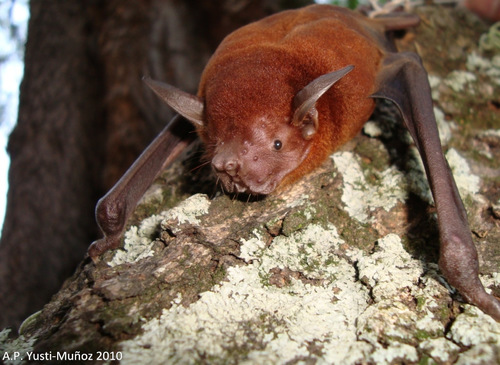
The greater bulldog bat, with the scientific name Noctilio leporinus (Linnaeus, 1758), is a large bat species. It typically has a combined head and body length of 10.9 to 12.7 cm (4.3 to 5.0 in) and weighs between 50 and 90 grams (1.8 to 3.2 oz). Males are generally larger than females: males average 67 grams (2.4 oz), while females average 56 grams (2.0 oz). The two sexes also differ in fur color: males have bright orange fur on the back, while females have dull gray fur. Both sexes have pale undersides, and may have a pale line running down the middle of the back. Male greater bulldog bats do not have a baculum.
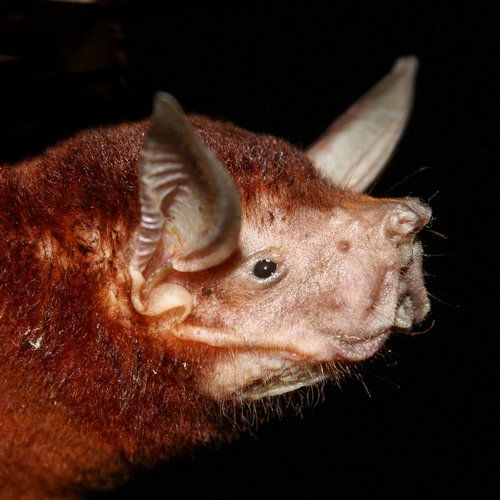
This species has rounded nostrils that open forward and downward. It has elongated, pointed ears, with a tragus that becomes ridged along its outer edge. It has smooth lips; the upper lip is split by a skin fold, and the lower lip has a wart positioned above skin folds that extend to the chin. These facial features resemble those of a bulldog, which gives the species its common name. The greater bulldog bat has a wingspan of 1 meter (3 feet). Its wing is longer than the combined length of its head and body, and the third digit makes up 65% of its total wingspan. Its wings move slowly when it is in flight. This species is a capable swimmer, and uses its wings to paddle through water. It also has prominent cheek pouches that it uses to hold food. Its hind legs and feet are unusually large, and can rotate 180 degrees when the bat is hunting. Its leg bones are noticeably compressed to create a streamlined shape when dragged through water.
The range of the greater bulldog bat extends from Mexico to northern Argentina, and includes most Caribbean islands. Though the species' range is large, it is patchily distributed, as the bat is mostly restricted to well-watered lowland areas, coastal areas, and river basins. There is geographical variation across the species, which is divided into three recognized subspecies. Bats in the Caribbean Basin belong to the subspecies N. l. mastivus; they are large, and usually have the pale mid-dorsal stripe, though their fur color varies. Bats in the Guianas and the Amazon Basin belong to the nominate subspecies N. l. leporinus; they are small and dark, and often lack the pale mid-dorsal stripe. Bats in eastern Bolivia, southern Brazil, and northern Argentina belong to N. l. rufenscenes; they tend to be larger and paler than the other two subspecies.
Greater bulldog bats live primarily in tropical lowlands. They are commonly found foraging over ponds, streams, estuaries, and coastal lagoons. They roost in colonies that can number in the hundreds. In Trinidad, they rest in hollow trees of species including silk-cotton, red mangrove, and balatá, and they also use hollow tree roosts in other regions. They additionally roost in deep sea caves. Like most bat species, greater bulldog bats are nocturnal.
Females roost together in stable groups, and these groups are typically accompanied by a single resident male. Females maintain associations with the same individuals in the same location for multiple years, and these associations are not disrupted by changes to the resident male or movement of the group to a new roost. A male may remain with a female group for two or more reproductive seasons. Bachelor males are separated from female groups, and may roost alone or in small bachelor groups. Females forage either alone or alongside their roost mates, and stable female groups continue to forage in the same areas long-term. Males forage alone, and use foraging areas that are larger than and separate from the areas used by females.
For female greater bulldog bats, pregnancy lasts from September to January, and lactation begins in November and continues through April. Each pregnancy produces only one young. Males mostly breed during autumn and winter. Young bats remain in the roost for one month before they become capable of flight. Both male and female adult greater bulldog bats care for the young.
The greater bulldog bat is one of the few bat species that has adapted to eat fish, and it feeds on both fish and insects. During the wet season, it feeds primarily on insects such as moths and beetles. During the dry season, it feeds primarily on fish, and also consumes crabs, scorpions, and shrimp less frequently. It mostly forages for fish during high tide, and locates prey using echolocation. When searching for prey, it flies high in the air in circular patterns. If it spots a jumping fish, it drops closer to the water surface near the site of the jump, and reduces both the duration and interval of its echolocation pulses. It may also search for prey by dragging its feet across the water surface, a behavior called raking. It will rake through areas where fish jump most often, or areas where it has previously made a successful catch.